BACKTEST WAVE DELETION: WHY 1,388 PASSES VANISHED
After 3,000 cells, we deleted 1,388 recorded passes. The six-leg ladder was sound, but its evidence pipeline was not, so none of those results could be trusted.
 DAAVILE Research Lab
November 14, 2026
11 min
Article
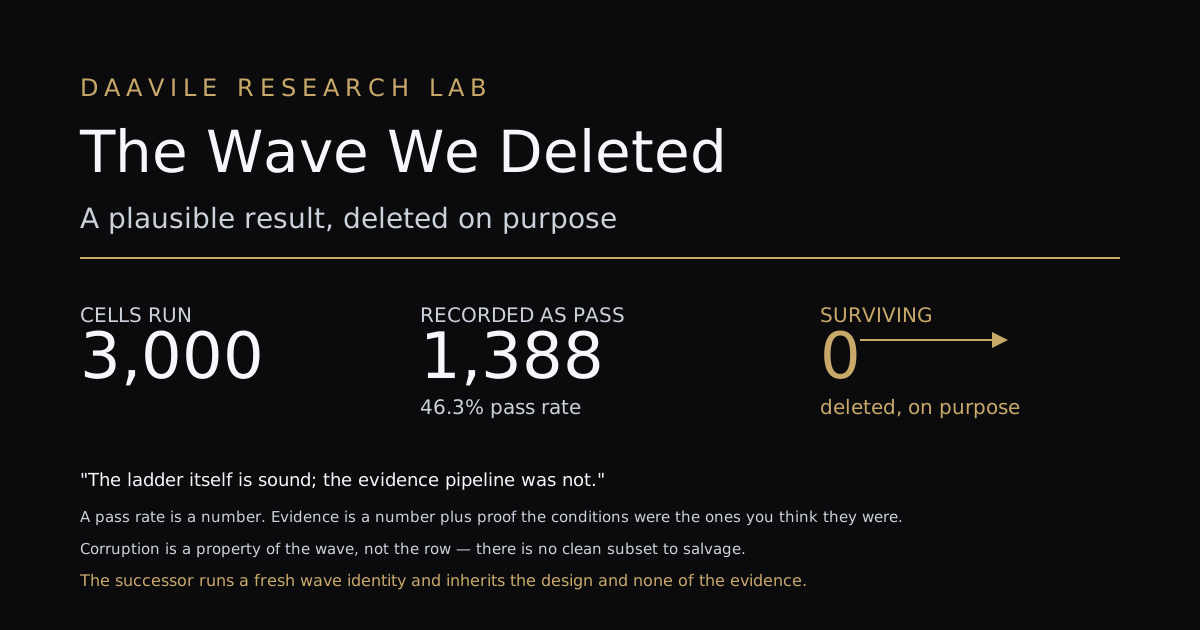
Six legs, two stages, and 3,000 cells produced 1,388 recorded passes. The 46.3% pass rate looked ordinary. We deleted every row: not archived, discounted, or quarantined for later. The wave's own protocol notes explain why. The ladder itself was sound, but the evidence pipeline was not.
A pass rate is a number. Evidence adds proof that the conditions behind it were the conditions you thought they were. When the pipeline is corrupt, a 46.3% pass rate is indistinguishable from a 0% one, and deleting it is the only honest move.
#The deleted wave ran six legs and two stages
The deleted wave ran the full six-leg ladder: four deterministic legs, then two random-perturbation legs. The protocol put legs one through four in stage one and legs five and six in stage two, with stage one gating stage two. It was the lab's first attempt at the complete ladder, and it is why the first full protocol exists at all.
| Leg | Condition | Stage |
|---|---|---|
| P1 | Clean baseline, no delay | 1 |
| P2 | Fixed 150 ms deterministic delay | 1 |
| P3 | Measured robustness, clean delay | 1 |
| P4 | Random jitter, no robustness axes | 1 |
| P5 | Random robustness axes, no delay | 2 |
| P6 | Jitter plus random noise | 2 |
The record of what it produced survives, and it is worth reading exactly as written. The wave recorded 1,388 of 3,000 cells as pass, 46.3%. That is the tombstone's content. A 46.3% pass rate on a full six-leg ladder is plausible, unremarkable, and believable, which is precisely the problem.
#Backtest wave deletion leaves no clean subset to save
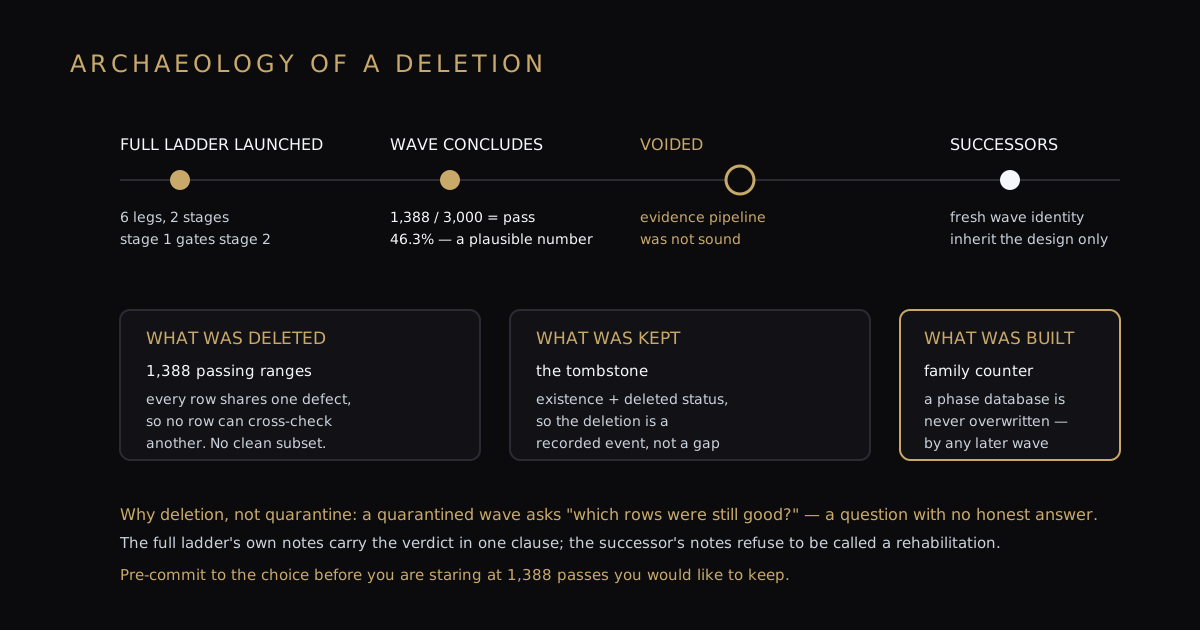
The instinct is to quarantine: mark the wave suspect, discount it, keep it in a corner. That instinct is wrong, and the reason is how a pipeline corrupts. A corrupt evidence pipeline does not fail loudly on one cell. It fails silently across the whole wave, in the same direction. Every row shares the same defect, so no row can be cross-checked against another one. There is no clean subset to salvage, because the contamination is not a property of individual cells; it is a property of the run that produced all of them.
Deletion is also the only action that cannot be misread later. A quarantined wave invites a future reader to ask "which parts were still good?", a question with no honest answer. A deleted wave invites exactly one question, and it has one: what did we fix? The lab's answer is the record itself, which keeps the tombstone and states the deletion as the outcome.
The ladder itself is sound; the evidence pipeline was not.
#Four protocol generations preserve the audit trail
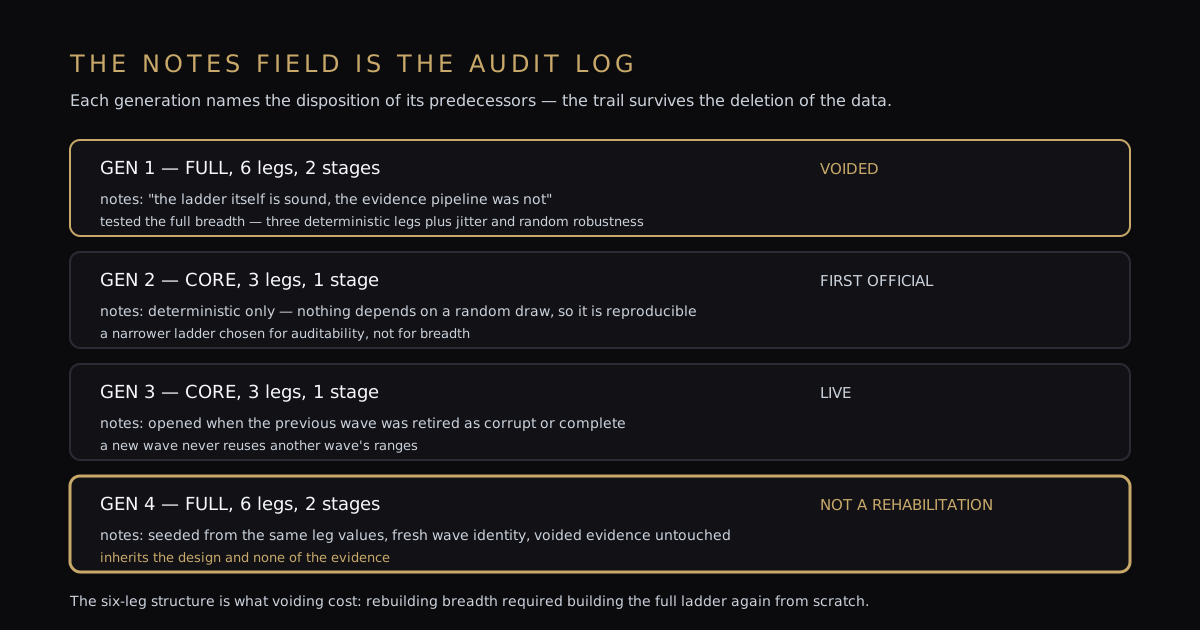
The deletion left the lab's most useful artifact: a trail. Four generations of protocol documents describe the same ladder, and their own notes are the audit log.
| Generation | Shape | Its own notes say |
|---|---|---|
| First full | 6 legs, 2 stages | The voided one — the evidence pipeline was not sound |
| First official | 3 legs, 1 stage | Deterministic only, so nothing depends on a random draw — reproducible |
| The live one | 3 legs, 1 stage | Opened when the previous wave was retired as corrupt or complete |
| The official full ladder | 6 legs, 2 stages | Seeded from the same leg values — but explicitly not a rehabilitation |
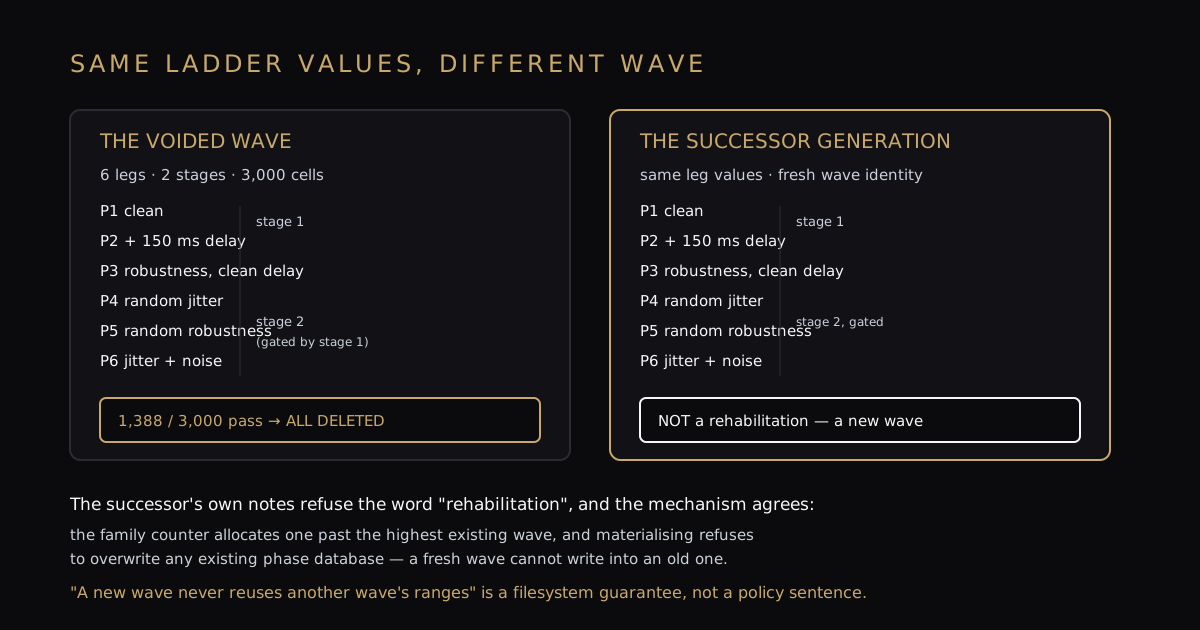
The rebuild refused to reuse the deleted wave's identity. It carried the same leg values, the same stage structure, and a different wave. The notes state the position in as many words: this is not a rehabilitation. The old evidence stays as it is (historical, untouched), and the new wave starts with nothing to inherit.
#Why the protocol notes are the audit log
The archaeology came from protocol documents, not memory. Every generation carries a notes field, and every generation's notes name the disposition of its predecessors. The first full ladder is marked as the voided one with the reason. The short core ladder is marked as the first official run on the grounds that it is deterministic-only, so nothing in it depends on a random draw. The live core records the conditions under which it opened. The rebuilt full ladder records that it is seeded from the same leg values and is not a rehabilitation. A protocol document is therefore a small audit log with the ladder attached, and the audit trail survives the deletion of the data it describes.
The audit trail survived the data deletion. The wave's data is gone and nothing can bring it back, but the record of what the wave was, what it claimed, and why those claims were refused is still readable in the documents' own words. The six-leg ladder tested the full structure: three deterministic legs plus random jitter, and the random robustness stage the shorter core ladders omit. Voiding it voided the only evidence the lab had produced at that breadth, so replacing it required building the full ladder again from scratch.
The new identity is enforced mechanically. Each new wave gets one past the highest existing family counter, and the materialising step refuses to overwrite any existing phase database. A new wave physically cannot write into an old wave's databases. "A new wave never reuses another wave's ranges" is not a policy sentence; it is a filesystem guarantee.
#The deletion produced four durable governance rules
Nothing about the deletion was waste. Four durable things came out of it, and they are still in force.
- The tombstone pattern. A deleted wave is recorded as a record with a status: the wave's existence and its outcome survive, even though its results do not. Nothing is silently made to disappear.
- The provenance rule. A successor protocol opens when the previous wave is retired as corrupt or complete, and wave identity is allocated by counter, so no two waves can collide.
- The immutable phase database. A phase database is never overwritten, ever, by any later wave.
- The five-clause audit pattern. Every protocol document carries a clause naming what happened to its predecessors, so the archaeology is readable from the documents themselves instead of from someone's memory.
| Temptation when a wave voids | The rule that refuses it |
|---|---|
| "Keep the good-looking rows" | Corruption is a property of the wave, not the row — there is no clean subset |
| "Reuse the old wave's identity to save the setup" | Fresh family counter; a phase database is never overwritten |
| "Call the rebuild a rehabilitation" | The successor is a new wave that inherits nothing but the design |
| "Quietly remove it and move on" | The tombstone and the status stay — deletion is a recorded event |
#A missing control turns a plausible pass rate into noise
This was not one bug in one pipeline. It was the general shape of what happens when a research process discovers that its instrument broke mid-campaign. The honest options were exactly two: prove which rows were clean, or delete the wave. Proving cleanliness required a control that ran clean at the start, which the deleted wave did not have. Only one option remained, and the lab took it.
The choice must be made before the stakes make it convenient. Deciding what you will do when the instrument breaks, before you are staring at 1,388 passes you would like to keep, separates a deletion from an erosion. An erosion is a lab slowly deciding that its numbers are probably fine. A deletion is a lab deciding they were not.
#Voided is not the same as discarded
Voided is not the same as discarded. A discarded wave was abandoned because it did not work: the strategy was weak, the numbers were ugly, attention moved on. A voided wave ran exactly as intended and was erased anyway, because the process that produced its numbers lost the right to describe them. The difference decides what survives. A discarded wave leaves nothing worth keeping. A voided wave leaves the design, the failure, and the rule that came out of it, which is why the voided six-leg ladder's leg values could be rebuilt while its 1,388 passes could not.
The lab keeps both statuses visible. A research process that can only show its successes has deleted its own audit trail. The tombstone lets the next person reading the protocol documents see which waves were abandoned as unpromising and which were voided as unproven, and tell those two situations apart without being told.
#The chain: how one bad pipeline voids a whole wave
One broken link can void every row. A pipeline is a chain, and a corrupt link does not fail at one point: it fails at every point downstream of itself, in the same direction, with no internal signal that anything is wrong.
- The ladder declares the legs correctly. This part was never the problem.
- The scheduling layer runs the legs. If a leg's semantics are settled by what the run record carries rather than by the ladder's declaration, the legs execute as whatever the record says, not as what the protocol meant.
- The evidence layer records the rows. A row faithfully records the number it was given; it cannot record the conditions that produced it, because those live in the binding, not in the row.
- The verdict layer reads the rows. Every check it performs passes, because the rows are internally consistent. They are consistent in the wrong conditions.
| Chain link | If it breaks | What the next link sees |
|---|---|---|
| Ladder declaration | The legs mean something other than what they say | Nothing — declarations are prose until they execute |
| Run record | The conditions that actually ran | Internally consistent rows, consistently wrong |
| Row storage | The number for the conditions that ran | Nothing anomalous — the row is faithful to its inputs |
| Verdict reading | The interpretation of a faithful row | Nothing — 1,388 plausible passes and no alarm |
Every link failed silently, passing clean inputs of the wrong kind. That is why the pass rate looked ordinary, and it shows how a research process can be wrong at scale without producing a suspicious result. The only exits were the two named above: prove the conditions, or delete the wave. The deleted wave had no control and no verified binding, so only one exit was available. Taking it turned 1,388 passes into information about the pipeline instead of false information about the strategy.
Every lab can test whether a result is evidence. Take a result you like and ask what, in the record, proves it came from the conditions you believe produced it. If the answer is a control cell that ran first and reproduced to the cent, the result is evidence. If the answer is that the number looked plausible and nobody had a reason to doubt it, the result is only a number. The deleted wave had 1,388 numbers of that second kind, and it took a whole deletion to turn them into information about the process that failed to check itself.
#Zero surviving cells can still strengthen the lab
Three thousand cells were run. One thousand three hundred and eighty-eight cells recorded as passing, 46.3%. Zero survive, and the lab is stronger for having deleted them, because what replaced them is a wave identity system that cannot be corrupted the same way twice. A research process is only as trustworthy as its willingness to throw away its own best-looking numbers when it learns they were not measured. This one threw away its best-looking wave, wrote down why, and built the successor so the same sentence could never be written again.
- A pass rate is a number; evidence adds proof the conditions were the ones you believed. The deleted wave had 1,388 numbers of the first kind.
- When the evidence pipeline is corrupt, no row is salvageable. Contamination is a property of the run, not of individual cells.
- Decide the void-before-you-see-the-numbers rule in advance. A control cell that ran first and reproduced to the cent is what turns a number into evidence.
The next step is simple: verify the instrument before trusting any wave score. The protocol archaeology, wave records, and every tombstone are in the DAAVILEFX Quantum research dashboard. See the safeguard in our bit-identical control cell, the execution checks in our latency tolerance ladder, and what survived in the published performance results.
#Questions we get asked
#What was deleted?
We deleted the evidence from a wave with 3,000 cells and 1,388 recorded passes, a 46.3% pass rate. The ladder was sound, but its evidence pipeline was not.
#Why not keep the passing cells?
The same defect contaminated every row, so there was no clean subset to save. Keeping the best-looking rows would have turned broken evidence into claims.
#What survived the deletion?
The tombstone, protocol documents, fresh wave identity, and the rule that a phase database is never overwritten. The next wave inherited the design but none of the old evidence.
#Was the work wasted?
No. The deletion produced four durable governance rules and exposed the missing control at the start of a wave. Those rules still shape how we test.