STRATEGY DIFF ANALYSIS: 5,690 DIFFERENCES, ABOUT 21 CAUSAL KEYS
We compared two strategy configuration files and found 5,690 numeric differences, then used four test periods to identify about 21 settings that changed trading behavior. Turning off the reverse-enable switch and applying the sixth causal adjustment reproduced the campaign's best-known result for one tested configuration bit for bit, although its range and phase (test period and condition) were not recorded here.
 DAAVILE Research Lab
November 14, 2026
11 min
Article
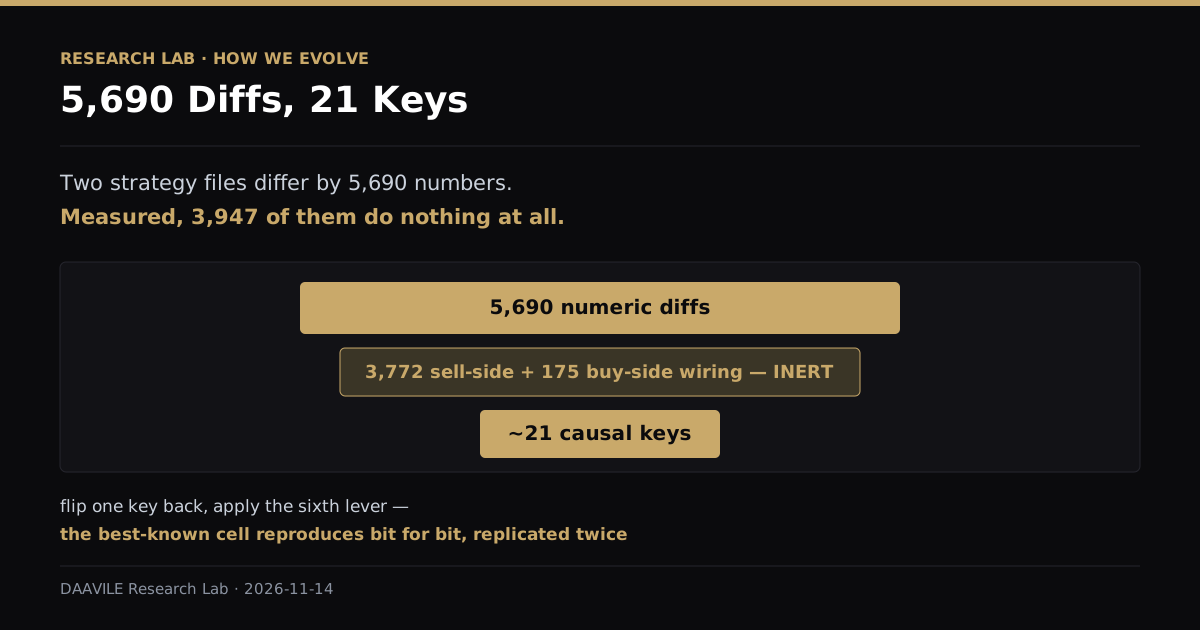
We received a rewritten strategy setfile and found 5,690 numeric differences between it and our champion. A setfile stores the strategy's numeric settings. The rewrite is our base, the existing reference is our champion, and the key-by-key comparison is a diff. Each key is one named setting.
We did not use those differences as a blind mutation list. A mutation batch creates variants to test, and running it across thousands of unexplained changes would have been a coin flip with extra steps. We would not know which keys carried the result, and any apparent improvement would be hard to separate from noise.
We tested the rewrite on four ranges, meaning four test periods. The runs separated behaviorally inert wiring from about 21 keys that changed trading behavior. Setting the reverse-enable switch to 0 and applying the sixth lever, or causal adjustment, reproduced the best-known cell bit for bit.
A cell is one configuration tested on one range under one phase condition. The phase identifies the test condition. The search narrowed, but the campaign remained unfinished.
The method was to diff, classify and measure the classification. Our bit-identical control supplies the proof standard for that last step.
#We counted the rewrite before testing its behavior
The first pass was arithmetic: base versus champion, key by key, with no interpretation or ranking. The count showed that we were dealing with a rewrite rather than a tuning change. Classification had to come before another batch.
We tested behavior rather than trusting setting names. When we restored a key's champion value in the base, we called the key inert only if the run stayed bit-identical to the base on all four ranges: the same profits, drawdowns and trade counts, to the cent. If restoring the value moved a number, we called it causal. Everything unmeasured remained a hypothesis.
#The first mode verdict used disabled trading slots
Before the classification runs, the numerical diff described the new base as the champion plus sell-side wiring changes, with no exclusive keys of its own. That was a testable claim.
Two early waves changed mode and identity settings while the relevant trading rules were switched off. They saw no response and recorded the mode paths as blocked. The next wave enabled an unused slot with an active reference, and the paths responded. Hazardous position sizes meant we could not accept that result.
We corrected the earlier entry instead of deleting it. The modes had never been blocked. The first tests had used disabled trading slots, so they could not reach them. A diff shows which values changed. Only runs show which changes alter behavior.
#Four-range tests separated inert wiring from causal keys
The tests marked 3,947 wiring keys inert: 3,772 on the sell side and 175 on the buy side. For each key, restoring its champion value left the base's profit, drawdown and trade count bit-identical on all four ranges. About 21 keys changed behavior. The campaign attributed its measured advantage to the settings behind five of the best-known cell's six levers, plus the reverse-enable switch those levers depend on. The measurement follows the clean separation demanded by our three-phase testing protocol.
The causal classification of about 21 keys is not an arithmetic remainder obtained by subtracting the inert keys from 5,690. The records do not categorize every remaining difference, so an unmeasured key remains a hypothesis.
| Measured group | Keys | What the runs showed |
|---|---|---|
| Numeric diffs, base vs champion | 5,690 | The raw count — a rewrite, not a tune |
| Sell-side wiring | 3,772 | Inert — bit-identical on all four ranges |
| Buy-side wiring | 175 | Inert — bit-identical on all four ranges |
| Causal keys identified | ~21 | Measured behavior change; not an arithmetic remainder |
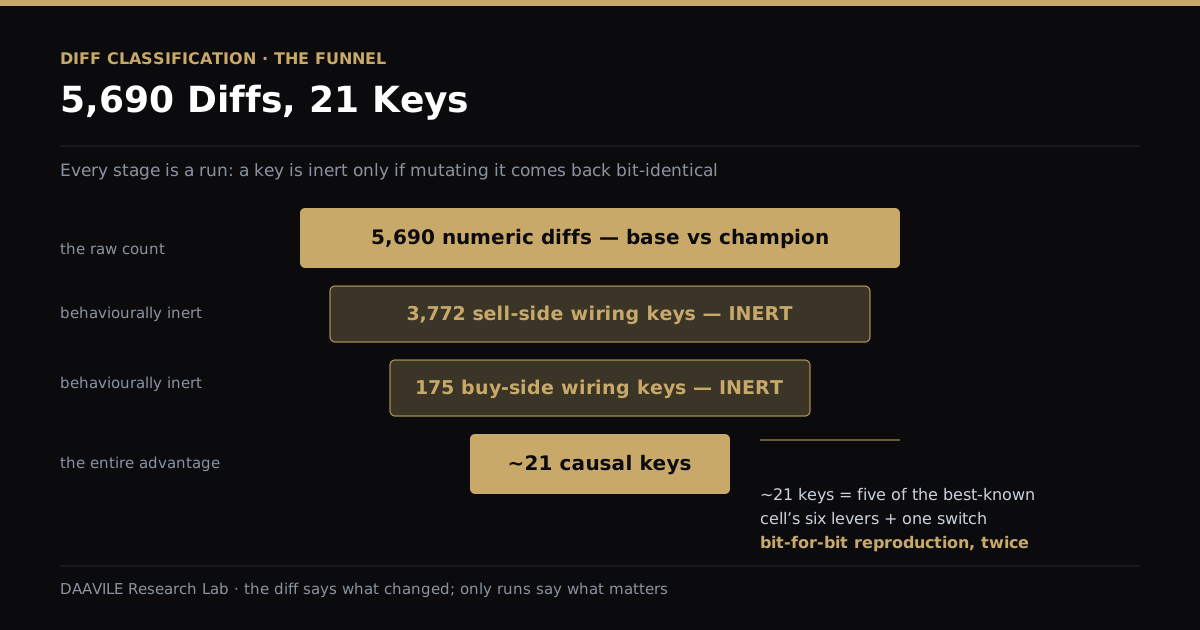
Classifying the inert majority changed the next batch's budget. Without it, a wave could spend four test values per setting on 3,947 keys that had no behavioral effect in this setup. The record would fill with "no effect" rows and could hide the two rows that mattered.
This inert verdict covers only the tested base and champion values, these logics and these four ranges. We recorded its date and scope, and a new range set would reopen the question.
Several inert keys had dramatic names, including hedge scale and reverse scale. They nevertheless came back bit-identical when restored on all four ranges. That run result, not the name, earned the classification.
#The new base's four-range results totaled 74,665.36 across 3,297 trades
With the classification done, we used the base's own four-range results as the reference for every later cell. All eight direction and mode master switches were on in the shipped base. For the first time in this campaign, the sell-side hedge and reverse paths were reachable.
| Range | Profit | Drawdown | Trades (buy / sell) |
|---|---|---|---|
| R1 | 28,165.27 | 12,533.04 | 1,209 (1,126 / 83) |
| R2 | 24,124.74 | 27,931.71 | 842 (742 / 100) |
| R3 | 9,040.20 | 10,361.51 | 342 (270 / 72) |
| R4 | 13,335.15 | 47,019.11 | 904 (830 / 74) |
| SUM | 74,665.36 | 97,845.37 | 3,297 (2,968 / 329) |
Reachable did not mean useful. Hedge and reverse could be added only through slots with zero contribution in the current base. Exactly five of these slots were dormant, meaning unused.
Using its shipped settings, one dormant slot fired 9,189 trades on the first range, 7.6× the base control's trade count, before the account ran out of free margin and the tester stopped at bar 160 of 276. FreeMargin fell to −2,981.68 and the final balance was 31,155.93. The recorded −68,844 belongs to the stopped run and is not a completed full-window loss.
A related activation totaled −257,685.07, and we marked both activations as failed. The cheap dormant grids barely traded: one added 3 trades on the first range and 1 on the fourth. Those added trades show low activity, not bit-identical inertness. The campaign record attributes the tight grid's failure to its trading side rather than its spacing, but the results do not isolate those causes. A reachable path can still fail on margin.
#Eight sell-side wiring families were measured inert on this base
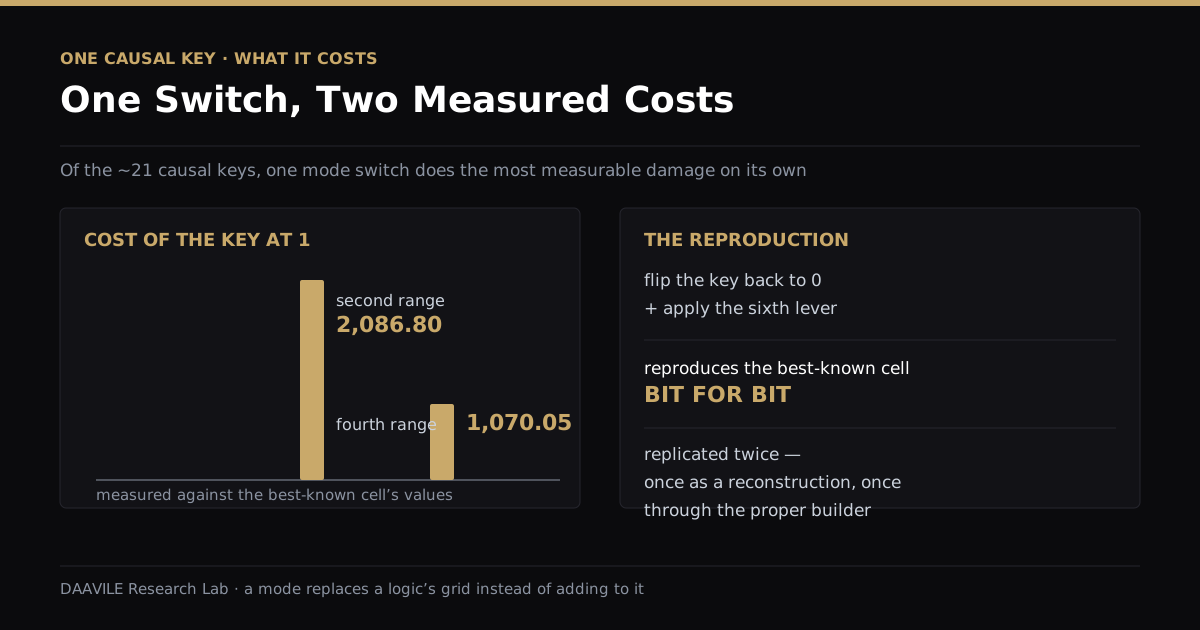
The numerical diff identified the 3,772 sell-side keys by name. Their families matched wiring we had already been investigating: hedge scaling, reverse scaling, compounding type, break-even mode, partial-close percentages and balances, grid type, and reverse-enabled flags.
These families had never been individually measured before this campaign. They were present on the sell logics of the new base and measured inert here. The family counts are not an additive breakdown of the 3,772-key classification, and the records do not explain how the counts reconcile.
| Wiring family | Keys | Verdict on this base |
|---|---|---|
| Partial-close balances (four slots) | 1,260 | Inert — bit-identical on all four ranges |
| Compounding type | 420 | Inert |
| Break-even mode | 420 | Inert |
| Partial-close percent | 420 | Inert |
| Hedge scale | 418 | Inert |
| Grid type | 380 | Inert |
| Reverse scale | 399 | Inert |
| Reverse-enabled flags | 98 | Inert |
#The reverse-enable comparison recorded a 2,086.80 cost on the second range
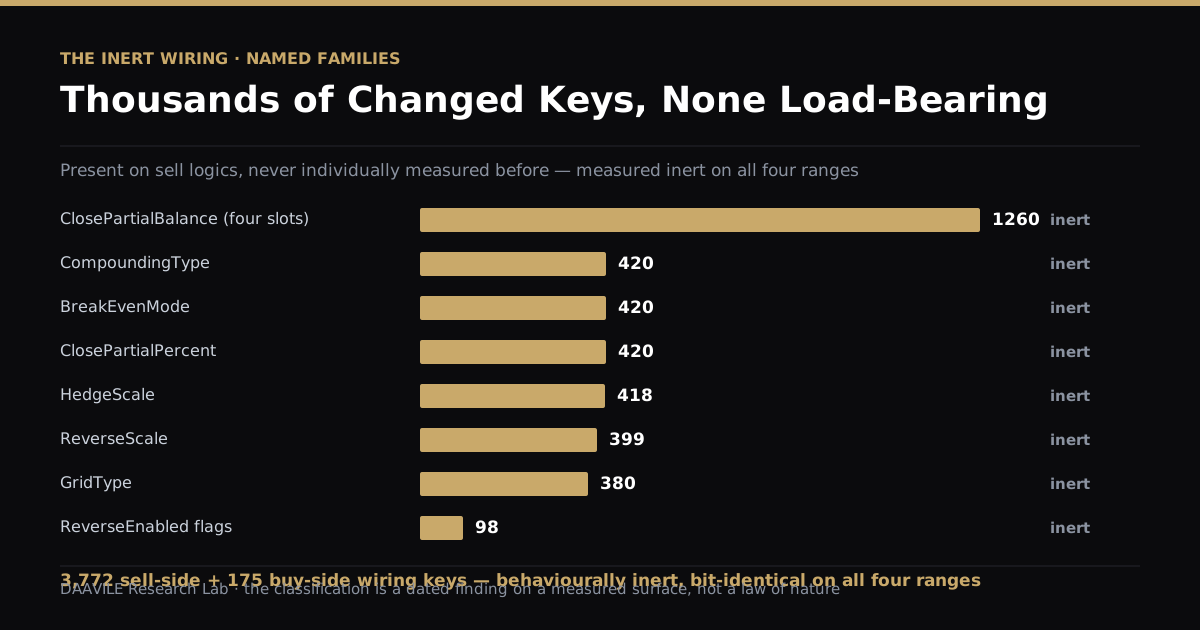
We measured the reverse-enable switch on its own. It was set to 1, meaning on, in the new base. Against the champion's best-known cell, the campaign recorded a cost of 2,086.80 on the second range and 1,070.05 on the fourth. That cell's range and phase were not recorded here, so we cannot treat these figures as a controlled comparison under the same range and phase.
The switch changes the strategy's mode rather than making a small tuning adjustment. A separate campaign test recorded a 68,255.98 summed loss when a live logic's mode was converted, because a mode replaces that logic's grid instead of adding to it. That separate sum is not a range-by-range decomposition of the reverse-enable differences.
We set the reverse-enable switch back to 0, meaning off, and applied the sixth lever, the lever missing from the base. The base reproduced the champion's best-known cell bit for bit.
We confirmed the identity twice: first by reconstruction, then through the campaign's builder. Those two paths verified the reproduction of that cell, not every member of the approximate 21-key classification.
#The champion's grid ladder did not transfer to the new base
Before running the ladder cells, we recorded a prediction: the champion's tuned grid values would not transfer. A grid ladder tests values one step tighter and one step wider than the current setting. If the base was the champion plus inert wiring and a handful of causal keys, its behavioral core had changed, so a peak measured on the champion had no reason to remain the peak.
| Grid ladder on the new base | Direction | Measured result |
|---|---|---|
| One step tighter | Down from the base value | −204,623 — poison |
| Base value | — | Peak on this base, on this base alone |
| One step wider | Up from the base value | −6,525 |
| Sibling grid, one step tighter | Down from the base value | −107,489 |
| Sibling grid, base value | — | Peak |
| Sibling grid, one step wider | Up from the base value | −566 |
Every move away from a base value was worse on both ladders, and all four resulting figures were negative. Both base values were the peaks in these records. The champion's registered peak for the sibling grid failed on this base, while the champion's peak for the first grid was already the base's own value.
The numerical diff made the prediction before the ladder cells ran, and the cells confirmed it to the cent. The next tuning work therefore starts from the base's own measurements, not inherited champion values.
#The search is narrower, but two ranges still miss their deposit bars
Across four ranges, the base totaled 74,665.36 on 3,297 trades (2,968 buy, 329 sell). The champion's grid stack reached 78,111.46 in the best-known cell. That cell's range and phase were not recorded here, so we cannot treat the totals as matching tests or subtract one from the other.
The campaign is not finished. The second range cleared its deposit bar by 928.35 at best. The third was 14,716.56 short and the fourth 10,308.80 short. You can compare that scope with the published DAAVILEFX results.
Every value ladder on this base was exhausted. What remains is whole-mechanism work that has never been run. We also still have to rule on the drawdown guard. That is our risk decision, not a key the diff can move.
- We counted 5,690 numeric differences before choosing another mutation batch, then measured which changes altered behavior.
- About 21 keys changed behavior on four ranges. Setting the reverse-enable switch back to 0 and applying the sixth lever reproduced the best-known cell bit for bit. That cell's range and phase were not recorded here.
- An inert classification covers the tested values, logics and four ranges. We dated that finding, and a new range set reopens the question.
Open the quantum dashboard to compare strategy files against live test data yourself.
#Questions we get asked
#How many strategy changes altered behavior?
About 21 keys changed behavior on four measured ranges. We counted 5,690 numeric differences. On those ranges, restoring each of 3,947 wiring keys to its reference value left the base's results bit-identical. The records do not categorize every remaining difference.
#What did the reverse-enable comparison record?
The switch was set to 1 (on) in the new base. The campaign recorded a cost of 2,086.80 on the second range and 1,070.05 on the fourth against the champion's best-known cell. That cell's range and phase were not recorded here, so we cannot treat the figures as a controlled comparison under the same range and phase. The switch changed the strategy's mode rather than making a small tuning adjustment.
#Did restoring the switch reproduce the best-known cell?
Yes. We set the reverse-enable switch to 0 (off) and applied the sixth lever. The base reproduced the champion's best-known cell bit for bit twice: first by reconstruction, then through the campaign's builder. The cell's range and phase were not recorded here. These two paths verify that reproduction, not every member of the approximate 21-key classification.
#Did the strategy diff analysis finish the campaign?
No, it narrowed the search. The second range cleared its deposit bar by 928.35 at best, while the third was 14,716.56 short and the fourth 10,308.80 short. Every value ladder on the base was exhausted. Whole-mechanism work that has never been run remains, and we still have to rule on the drawdown guard.