MT5 RESEARCH DESK: STOP REBUILDING RUNS FROM FILENAMES
The MT5 research desk keeps run identity, campaign evidence, and tester actions separate, so humans and agents never rebuild a run from filenames.
 DAAVILE Research Lab
November 14, 2026
12 min
Article
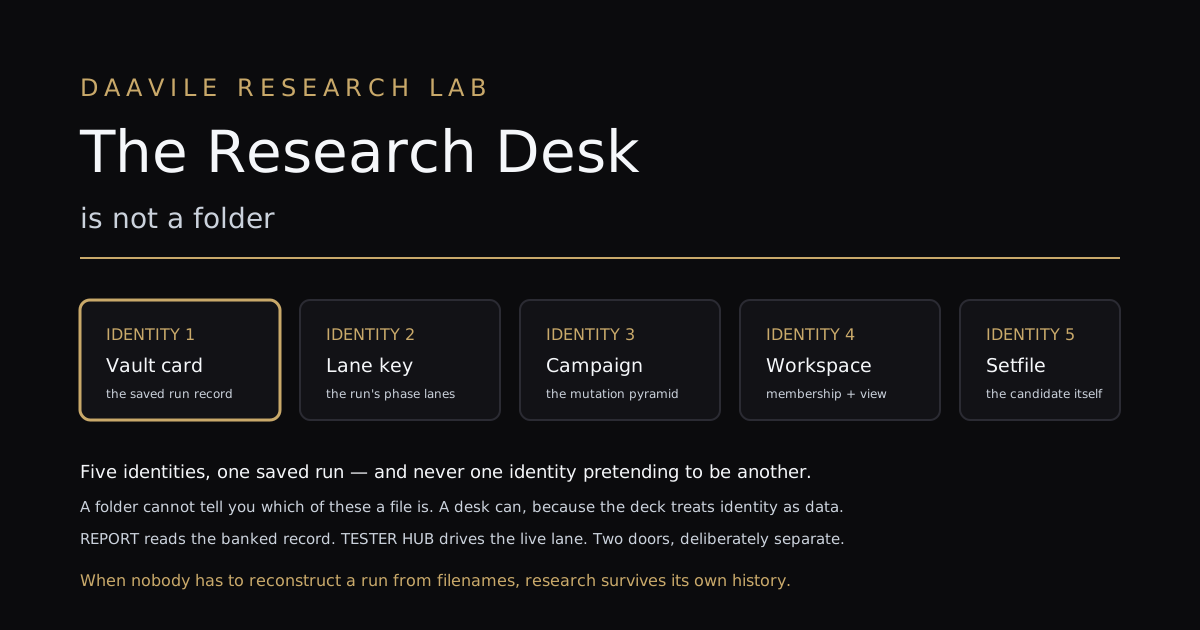
An MT5 research desk turns a backtest from a loose file into a record we can prove. The failure rarely starts with a bad strategy. It starts with a setfile called "final", a report copied into chat, and a terminal left running after the test. Weeks later, nobody can say which configuration produced which result.
We built the MT5 Deck to close that gap. It organizes MetaTrader 5 runs, saved evidence, mutations, and agent work on the operator's own machine, so run identity becomes data instead of something somebody has to remember. The whole system fits in five numbers: 5 run identities, 2 deliberate doors, 4 journal proofs, and 1 definition of a range. None of it is decoration. These rules stop a research archive from quietly changing its story.
#Why an MT5 research desk beats a folder
A folder is excellent at holding files. It is terrible at explaining relationships. A file name cannot reliably tell us whether it belongs to a saved run, a live lane, a mutation campaign, a workspace, or a candidate configuration. It certainly cannot tell us which of those things a later report was reading.
The deck replaces that guesswork with explicit records and owners. Each answer has one source of truth, and no object is forced to impersonate another. The result is less glamorous than a folder and far more useful.
| What folders do | What the research desk does |
|---|---|
| Let names carry several meanings at once. | Keeps the vault card, lane, campaign, workspace, and setfile as separate identities. |
| Mix a banked report with whatever the live view currently shows. | Separates saved evidence from live lane evidence. |
| Pool results across conditions. | Keeps each phase’s results independent and labels every range by its time window. |
| Treat a green progress bar as success. | Requires journal receipts before a test leg is done. |
Assistants handle detailed inspection and repeatable operations; humans choose the objective, set the constraints, and review consequential decisions. Both sides act through structured application tools without scraping a screen or reconstructing a run from a filename.
That promise removes a tempting shortcut: "I remember which one that was." We do. Until somebody can prove it.
#What the MT5 research desk actually is
The MT5 Deck is a local-first desktop application surface for organizing runs, reading saved evidence, comparing mutations, and orchestrating work. Its records stay on disk and inside the application's own data model. There is no remote database standing between the person asking a question and the evidence needed to answer it.
The desk is not one giant table. It has a small set of surfaces, each with a clear job.
| Surface | Its job |
|---|---|
| Tester Hub Overview | Shows the selected lane, campaign, baseline, candidate, phase, and evidence coverage. |
| RUNS strip | Selects a lane in the active workspace; its separate pin control changes which lane the engine follows. |
| Vault | Finds, classifies, archives, exports, compares, and reopens saved run cards. |
| Vault REPORT | Opens one card’s own results inside the Vault, with the Hub Overview embedded for that run. |
| Vault TESTER HUB | Navigates to the shared Hub, switches workspace when known, and opens the selected lane tab. |
| Settings and help | Explains the workflow and definitions without changing a run. |
Behind those surfaces sit different record owners. Run definitions register materialized lanes. Phase databases hold phase evidence. The campaign registry stores mutation configuration, candidates, and rows. Saved report packages supply a card's banked results. No single file is allowed to pretend it owns every field.
That is why the desk can be both simple and strict. The interface stays narrow while the records underneath remain precise enough for an agent to inspect, replay, and report without guessing.
#Five run identities that must never collapse
The heart of the product is a 5-part identity model. Each identity answers one question, and each has a different owner. Collapse any two and you create a new way to attach the wrong evidence to the wrong run.
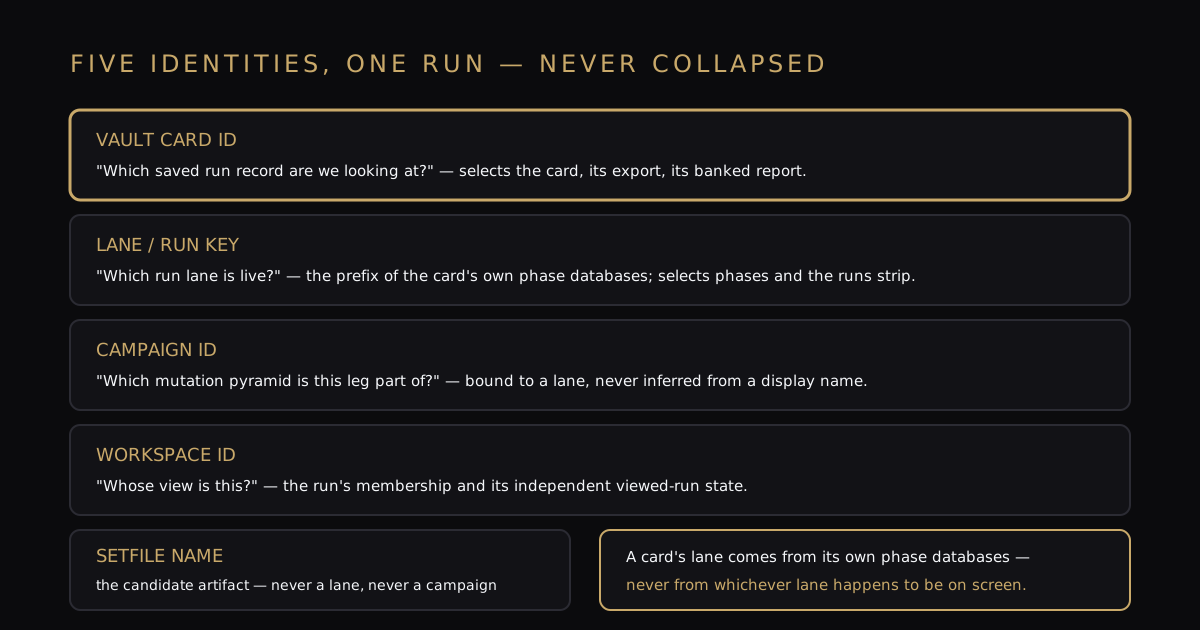
| Identity | What it identifies | What it must not be used for |
|---|---|---|
| Vault card | The saved run record, its export, and its banked report. | It is not a live lane or a workspace membership. |
| Lane / run key | The run selected by the Deck, phase databases, and RUNS tabs. | It is not inferred from the currently visible Deck state. |
| Campaign | The mutation campaign that holds candidates and evidence. | It is not bound by guessing from a display name or shared candidate. |
| Workspace | The run’s membership and the independently stored viewed-run state for that world. | It is not the card ID or campaign ID. |
| Setfile | The tested EA configuration used as a candidate artifact. | It does not identify a lane, workspace, or campaign. |
The rules are direct. A card's lane is derived from that card's own phase databases, even if another live run is selected elsewhere. A run's classification comes from explicit metadata, not a familiar word in its label. A display name can help a person scan the list; it cannot replace stored truth.
The same discipline applies to campaigns. A campaign is explicitly bound to a lane, even if an old document happens to reuse a familiar campaign name. The app follows the explicit binding rather than whichever set of candidates happens to resemble the current selection.
#Why REPORT and TESTER HUB are deliberately separate actions
Every saved Vault card offers two exits. They look related, but they do different jobs, and the separation is a contract rather than a UI detail.
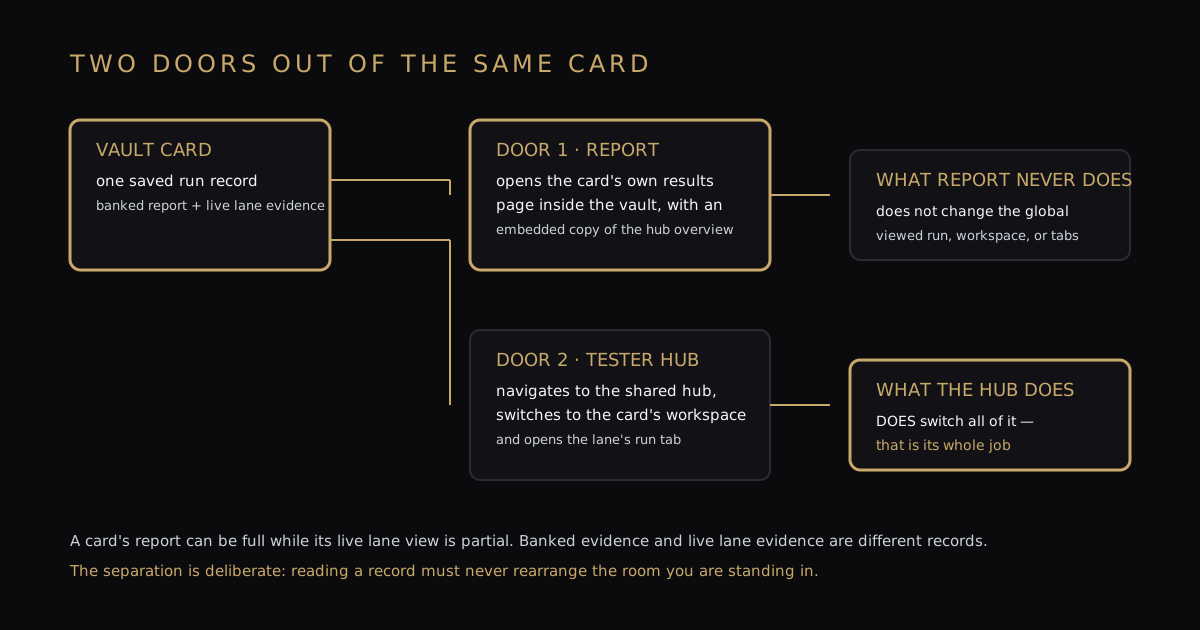
| Action | What changes | What deliberately stays unchanged |
|---|---|---|
| REPORT | Opens the selected card’s results and embeds the Overview scoped to that card’s lane. | The global workspace, viewed run, RUNS strip, and hidden-tab state. |
| TESTER HUB | Refreshes workspace membership, restores the lane tab, selects the Hub overview, and writes the viewed lane. | Nothing global is left untouched; changing the live view is the purpose of the action. |
Why go to the trouble? Because a saved report can be complete while the current phase-database view is partial. That is normal during recovery and during an active wave. The banked record and the live lane are different snapshots, so the deck never lets the newer partial view erase rows that already exist in the full campaign snapshot.
There is another practical consequence. Embedded Overview controls can still update the campaign bound to that card's lane, even though the route remains inside the Vault. A local action can be real without becoming a global navigation event.
You can see the same discipline in the research results library: saved evidence stays attributable to the run that produced it.
#The agent dropbox is the safe outside door
Agents need a way to add candidates without writing over the registry the app is actively using. The agent dropbox is that door. An agent submits a durable file; the application watches the dropbox, ingests it, and updates the campaign registry through its own recovery path.
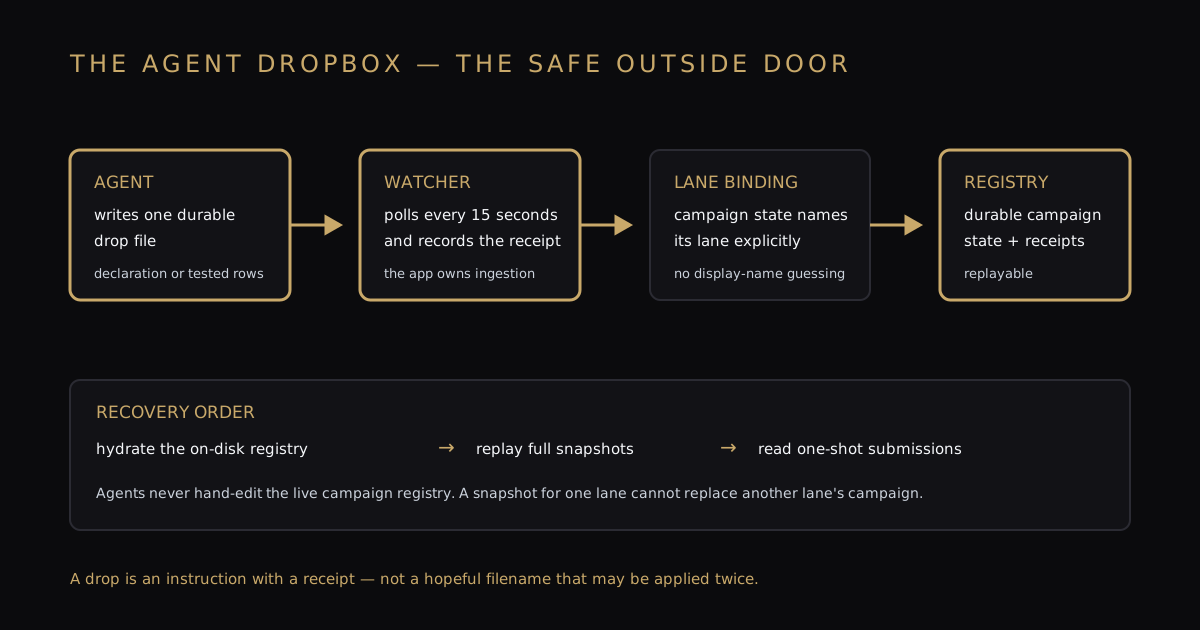
The watcher polls the dropbox every 15 seconds. It can receive a name-only declaration for a candidate skeleton or a submission with real rows after the candidate has been tested. Once ingested, the file receipt is recorded on the campaign, so the same drop is not silently applied again.
Durable snapshots come before one-shot submissions during recovery. The app first hydrates the on-disk registry, then replays full campaign snapshots, then reads individual submissions. That order protects banked rows and makes agent work replayable.
| Move | Rule |
|---|---|
| Declare a candidate | Submit a name-only skeleton through the dropbox. |
| Submit tested rows | Use a submission that carries the actual evidence rows. |
| Bind the campaign | Use the explicit lane binding carried by the campaign state. |
| Update the registry | Let the watcher ingest the drop; agents never hand-edit the live campaign registry. |
The registry is a merged history, not a scratch file. A snapshot from one lane must never replace another lane's campaign just because they share a campaign ID or a candidate setfile. The wider agentic verification loop builds on that same record-first rule.
#How a test run becomes banked evidence
Most tools treat a run as finished when the process exits. The deck asks for more: a leg is done only when its evidence is attached to the right phase and backed by receipts. That turns a terminal session into something the next person can trust.
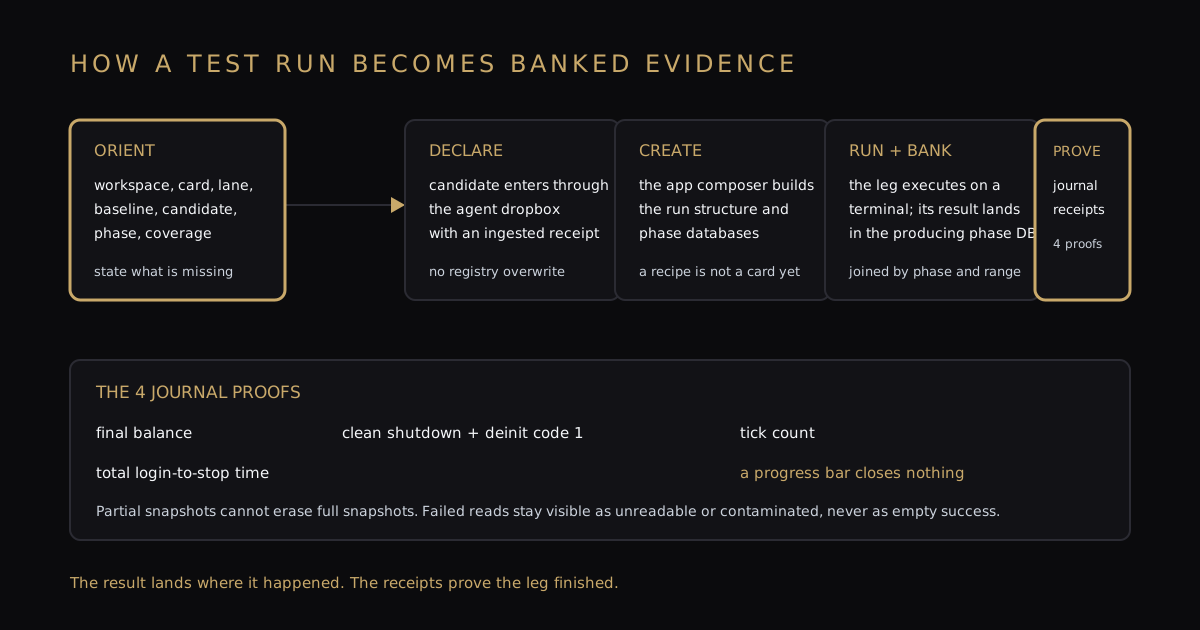
Human and assistant operators follow the same loop. It starts by orienting the desk, then inspecting the correct evidence sources, planning the exact action, acting through the application, and reporting what changed.
| Step | The discipline |
|---|---|
| Orient | Identify workspace, card, lane, protocol, mode, baseline, candidate, and evidence coverage. Say what is missing. |
| Inspect | Read banked card evidence from the saved report and mutation evidence from the lane-bound campaign. |
| Plan | Name the exact lane, candidate, phase, range layer, terminal plan, and proof of completion before acting. |
| Act | Use the deck’s structured tools and durable records. Never substitute another run, baseline, or workspace without saying so. |
| Report | State what changed, what is banked, what is pending, which gates failed, and where the records live. |
Creating the run is part of that chain, not a folder operation. The application's own composer materializes the run structure on disk and prepares its phase databases. A run definition is a recipe; it does not become a saved Vault card merely because the definition exists.
The final step is strict. A test leg needs 4 journal proofs: the final balance, the clean shutdown record with deinitialization code 1, the tick count, and the total time from login to stop. These receipts belong to the leg's journal. A visual progress indicator proves nothing.
Evidence then joins by phase and range. A partial snapshot cannot erase a full snapshot. A failed phase-database read appears as unreadable or contaminated rather than an empty success, and failed reads are not cached as real empty data. Absence stays visible as absence.
The wider testing method has the same discipline. The control leg comes before the comparison wave. Our bit-identical control guide explains why; otherwise the wave has nothing trustworthy to compare against.
#The unit law: one range is one period of time
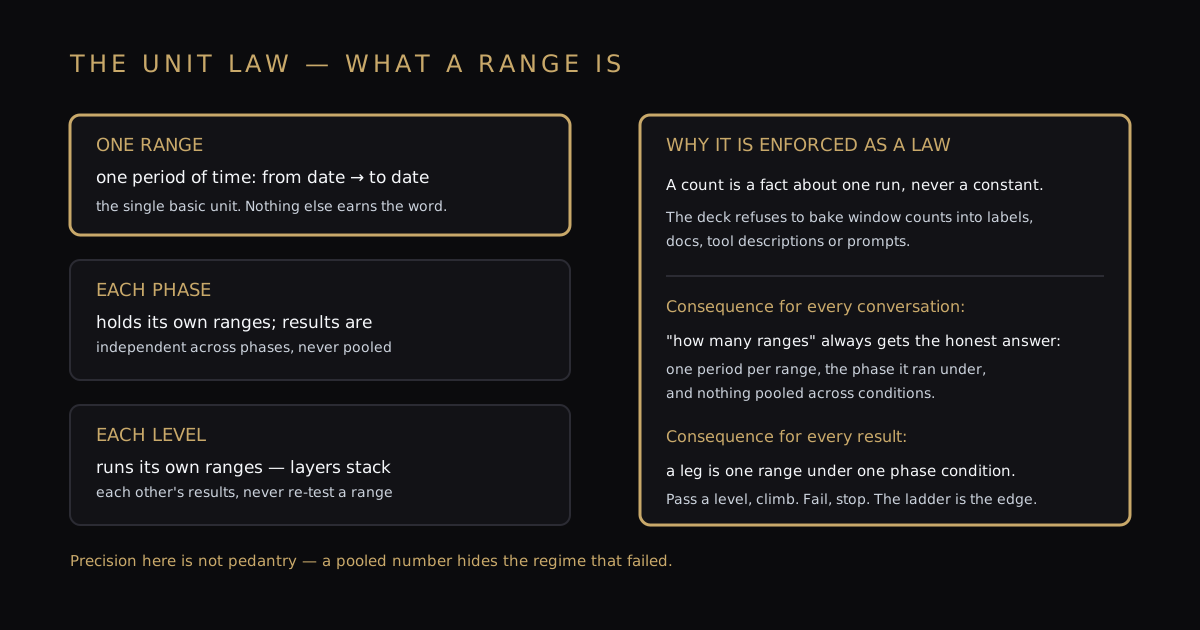
Identity only helps if the units are honest. A range means one period of time: a from date and a to date. Nothing else earns the word.
| Term | What it means in the deck |
|---|---|
| Range | One from-to period of time; the basic unit of the deck. |
| Phase | A condition with its own ranges and independent results. |
| Level | A rung with its own ranges; levels stack results rather than repeat them. |
| Count | A fact about a specific run, not a constant baked into the application. |
The count carries its unit everywhere it appears. A protocol can declare whether it counts ranges or phase-range legs, and the expected totals, explanatory notes, and matrix caption all derive from that one declaration. A bare expected number without its unit is treated as a defect.
This is why the three test phases remain separate. Each phase keeps its own evidence. You can read how the three phases answer one question in its own article. The deck never averages the conditions together and calls that one result.
No specific number of windows is a law. It belongs to a run, a protocol, or an operator's choice. Keeping that fact visible prevents a convenient headline from hiding the rung that failed.
- Keep identity explicit. A saved card, live lane, campaign, workspace, and setfile answer different questions.
- Keep reading separate from navigation. REPORT opens evidence; TESTER HUB changes the live view.
- Keep claims tied to receipts. A range has one time window, and a finished leg has proof.
#Questions we get asked
#Is the MT5 research desk just a nicer folder?
No. It is an application that records relationships between runs, lanes, campaigns, workspaces, candidates, and evidence. The files still matter, but they are no longer asked to carry every identity at once.
#Why can't REPORT and TESTER HUB use the same button?
Because one reads a card's saved record without touching global state; the other navigates to the shared Hub and changes the live lane. Merging them would make "open this evidence" silently mean "switch what I'm looking at".
#Can an agent add a candidate by editing the campaign registry?
No. The agent dropbox is the safe outside door. The application watches durable drops, records what it ingested, and owns the campaign update.
#How do we know a test leg is really finished?
We require all 4 journal proofs: final balance, clean shutdown with the expected deinitialization code, tick count, and login-to-stop time. A process that merely stopped is not the same claim.
#Does the desk pick the best strategy for us?
No. It makes the evidence reviewable and keeps the operator in charge of the objective, constraints, and consequential decisions.
Open the live MT5 research desk in the Quantum research workspace and see the saved runs, campaigns, and evidence as one accountable system.