PORTFOLIO
Protect capital first. Deploy exposure when the market state justifies it.
The verified record and the validation framework are presented separately, so a reader sees what has been demonstrated and how each version is evaluated.
Lot size and risk are adjusted to each client's balance and agreed risk and profit expectations. Statement lots are observations, not a prescription.
The DAAVILE Portfolio is an investing and trading framework built around one discipline: protect capital first, then deploy exposure when the market state justifies it. Investing does not require high leverage. The system models on every tick based on real ticks, measures risk through both realized and floating drawdown, and validates each version through a pre-registered framework.
The historical record and the validation framework are presented separately. A reader sees what has been demonstrated and how each version is evaluated.
Leverage is an exposure control, not the source of edge. Edge comes from state recognition, execution and inventory management. Leverage changes the scale and path of exposure.
Active trading may press an opportunity aggressively using experience in leveraged markets. Investing waits for the market to establish tone and trend before committing more margin. Investing does not begin at maximum exposure.
Client capital is preserved first and deployed selectively. The operator uses the same strategy and risk process on his own capital. Broker liquidation is the mechanical boundary, not the intended risk mechanism.
At a glance
DAAVILE is a deterministic MQL5 execution framework for directional reversion on XAUUSD. Its architecture combines independently parameterized directional books, execution-derived cycle state, basket-level inventory exits, cross-logic closure cascades, configurable risk enforcement, and a disciplined validation and promotion process.
Evidence status
Portfolio 1 and Portfolio 2, each within its own version, configuration and purpose. No cross-version pooling.
MQL5 18.x source and build. Build receipt: 0 errors, 0 warnings. No live-capital evidence for 2026 work.
v4 forward, out-of-sample and live-deployment gates. A framework being built is not a result already obtained.
Lineage, not one blended record
Invariant thesis, versioned implementation. The directional-reversion thesis and base architecture stay constant while calibration, execution mechanics and risk configuration are versioned and revalidated. Controlled evolution, not style drift.
| Domain | Characterization | What may be claimed |
|---|---|---|
| Portfolio 1 · Dec 2021 – Feb 2024 | v1+v2, aggressive, fully compounded stress test | Stress research, survival evidence, aggressive-configuration performance |
| Portfolio 2 · Oct 2024 – Sep 2025 | v3, conservative client configuration | Client-delivery evidence under conservative sizing |
| 2026 · v4 / 18.03 | New strategies, pipeline and protocol R&D, no live capital | Current source architecture and research progress |
| 2027 | Planned resumption | Deployment intent, subject to validation gates |
Analytics enforce lineage with version_tag, config_tag and phase_tag. No default cross-version "all data" query is permitted.
Verified performance
| Measure | Portfolio 1 | Portfolio 2 |
|---|---|---|
| Period | Dec 2021 – Feb 2024 | Oct 2024 – Sep 2025 |
| Broker | RoboForex | TeleTrade |
| Total return | +147.2% | +46.06% |
| Max / realized drawdown (closed-trade) | 14.8% | 0.80% |
| Win rate | 78.4% | 66.5% |
| Profit factor | 2.18 | 3.79 |
| Trades | n/a | 3,009 |
| Benchmark (S&P 500, original window) | 6.93% | 17.23% |
| Verification | Audited statements | FXBlue, platform-verified, client account |
$55,360.00 deposit + $22,749.57 market P&L + $2,747.56 secured rebate = $80,857.13 final balance.
System definition
DAAVILE is a systematic, rules-based mean-reversion trading system on XAUUSD. It takes directional reversion risk through a configurable logic grid, and broker rebates offset execution costs. In the verified record, 89% of profit came from market P&L.
A trader running a machine. The execution kernel is deterministic and tick-level. Disclosed governance overrides sit outside the kernel.
Not a market maker, signal service, or black box. Inventory progression is bounded and configuration-governed, with optional declining multipliers and explicit exits.
It holds a structure, not a forecast. Price movement triggers programmed responses. The Kernel Configuration is the authority inside execution.
Mean reversion is the bet that stretched prices tend to come back. The grid turns that bet into a shopping list: as price falls, the system buys small fixed slices at set intervals, and it closes them when the average price of the whole basket has recovered. Imagine scaling into a stock you expect to recover, with the size, the spacing and the exit written down before the first buy. The engine runs that list on both sides of the market, at tick speed, without deciding anything mid-trade.
The attribution that decides the label
Market P&L is $22,749.57, or 89.22% of profit. The rebate is $2,747.56, or 10.78%. Most of the money comes from being right on price. Rebates are 100% verified: free money for clients and an extra layer of protection. Depending on broker conditions and client status, they add roughly 10% to 20% a year. In Portfolio 2, about 36% of the return came from trading profits and about 10% from rebates. They are not the edge. The trading thesis does not depend on any particular broker offer; RoboForex and TeleTrade simply run different programs.
| Market maker | DAAVILE, systematic trader | |
|---|---|---|
| Edge | Spread, rebate and flow | Directional reversion skill, sized |
| Posture | Delta-neutral, inventory-managed | Directional, long-biased in this sample |
| Killed by | Adverse selection, inventory blowup | Being wrong on direction and sized too big |
| Metric | Rebate per lot, fill rate | Expectancy per trade, profit factor, recovery |
The reported $7.56 expectancy, 3.79 profit factor and 66.5% win rate are trading metrics.
Operating doctrine
Stress-model the danger at higher intensity. Deploy client capital with a reserve. Accept exposure only in approved states, and deny further exposure when the state invalidates the position.
| Mode | Margin doctrine |
|---|---|
| Active trading | The operator may press an opportunity aggressively, using experience in leveraged, high-volatility markets. |
| Investing | The system waits for the market to establish tone and trend before committing more margin. High leverage is not required. |
The three outcomes of leverage
- It can amplify profitable exposure.
- It can accelerate losses and broker liquidation.
- It can support protection when stress-modelling and live deployment use different exposure levels.
Model under more demanding leverage assumptions to locate failure. Deploy at lower effective exposure to preserve a margin reserve. At a predefined state the system may accept an opportunity; if that state deteriorates, further exposure is denied and the risk layer limits margin commitment.
Leverage is a megaphone, not a microphone for skill: it makes outcomes louder in both directions. The doctrine is to rehearse with the megaphone at full volume in testing, then speak quietly with client capital, keeping the loud setting for states the system was designed to survive.
Client capital is capital to preserve first and deploy selectively. The operator uses the same strategy and risk process on his own capital and does not offer a structure he does not trust or use himself.
Architecture
DAAVILE 18.x is a deterministic, state-driven MQL5 execution framework: three engines, seven logic families and two directional books across 20 configuration groups. Standard, reverse and hedge cycle modes are explicit.
The current 18.x source is a deterministic, tick-level execution framework. Cycle state is derived from the active cycle's first open ticket, time and price. First-to-last AVG% basket exits and direction-local CloseTargets cascades are implemented. Configurable floating-loss, position-cap, trim and anti-grid controls sit above the kernel. Build receipt: 0 errors, 0 warnings. No live-capital result is claimed for this build.
A cycle is one round trip of the book. It opens with a first ticket and ends when the basket closes. The engine remembers that first ticket the way a chess player remembers where the game began, and it manages every later position relative to it. The basket exit is the checkout: when the average price of everything held has moved enough and price has pulled back, the book closes from the first position to the last.
Naming scheme
| Layer | Name | What it signals |
|---|---|---|
| System | DAAVILE Execution Kernel | Core deterministic engine that every other component calls |
| Configuration | Kernel Configuration | Specific parameterization, sparsely activated by state |
| Logic structure | Logic Matrix | 21 buy × 21 sell configurable slots with engineered interactions |
| Validation | Legacy broad-sample research · current controlled mutation · planned forward validation | Evidence separated by status, not blended into one claim |
| State handling | Operational state evaluation and conditional response | Immediate, bar, time, pip, session, news and order-count triggers |
| Execution property | Deterministic, tick-level, kernel-nondiscretionary | Disclosed governance overrides sit outside the kernel |
Calibration status
| Work stream | Status |
|---|---|
| Legacy broad-sample research (IS, held-out, rolling) | Separate historical work stream, not evidence for current 18.03 |
| Current controlled mutation | Fixed configuration loaded; no holdout in the current doctrine |
| Forward validation | Planned under MASTER_INV_2, not completed |
The Execution Kernel runs on a large parameter space, sparsely and conditionally activated across 21 × 21 configurable logic slots. Sparse activation means effective dimensionality per state is lower than raw parameter count. Raw parameter count is not presented as proof of generalization; the live record and forward tests carry that burden.
Module families · verified Portfolio 2 statement
| Family | Magic | Function | Observed lot |
|---|---|---|---|
| ML-A | 888 | Primary ladder, deepest averaging, widest spacing | 0.01 |
| ML-B | 621600 | Secondary ladder, closer spacing, larger clips | 0.02 – 0.04 |
| ML-C | 1243200 | Fast cycle, short holds, quick turnover | 0.01 – 0.02 |
| Scalp | 177600 | High-frequency reversion harvesting | 0.01 – 0.03 |
| LT-ScalpBuy #7 | 155400 | Outlier ladder clip, four trades in April–May 2025 | 0.01 – 0.34 |
| SCA | 532800 | Structural continuation entries | 0.01 – 0.02 |
| BRepower | 710400 | Inventory repowering after partial close | 0.01 – 0.03 |
| Stopper | 266400 | Equity protection module | 0.01 |
| BScalp | 799200 | Secondary scalp module | 0.01 |
| STO | 444000 | Protective overlay | 0.01 |
| LT (unlabeled) | 355200 | Long-term structural entries | 0.01 – 0.02 |
The 21-per-side count refers to configurable logic slots, not fully independent modules. CloseTargets and other gates create intentional interactions between slots.
Rung structure
Entry begins at 0.01 lots and scales upward through the ladder. Spacing, progression and maximum rung count are defined per logic module, not globally. Progression modes are configurable, including declining multipliers.
A $1,000 real deposit is denominated as a 100,000-unit balance. Each nominal 0.01 lot carries 1/100th the real-dollar risk of a standard account. This makes 21-rung granularity per side viable at low real capital.
Minimum viable capital: $10,000 at 1:50 leverage.
Observed lots come from one client statement and are not a universal prescription. Position size is set from the client's balance and the agreed risk and profit expectations. The 0.34-lot trades in the record belong to magic 155400, an outlier ladder clip, not to the 177600 scalp module. On a cent account, lot size maps to real-dollar risk differently than on a standard account, so the same nominal lot is not the same exposure across account types.
Cycle modes
| Mode | Description |
|---|---|
| Standard | Default cycle behavior on the active directional book |
| Reverse | Direction-local reverse ownership and response |
| Hedge | Opposing book engaged to manage net exposure |
| Only-buy / only-sell | One side active, the other dormant |
Magic-number assignment determines coupling. Different magic numbers keep books independent with side-specific exits. A shared magic number couples them, and basket-level exits trigger across both books, first-to-last.
Engineered interactions and controls
- First-to-last AVG% basket exits: computed from the open-price span of a basket, not a single position.
- Direction-local CloseTargets cascades: a source basket can close and dispatch exits to other families.
- Configurable single-position loss action, aggregate floating-loss action, position caps, trimming and anti-grid gates.
- Broker retries, requote refresh and post-fill slippage measurement.
- RobustnessLab: tester-only, seed-controlled noise, shift, skip, slippage, exit friction and spread bursts.
Execution model
Tick-level and deterministic. OnTick maintains the order cache and evaluates existing-trade management every tick. The kernel has no runtime discretion; disclosed governance overrides sit outside it.
- Tick-level, deterministic. Decisions are made on tick data, not on bar close.
- Continuous, 24/5. The cycle runs whenever the market is open.
- Optional software TP/SL disabled in the audited configuration. Risk is managed through sizing, spacing, rung count, margin reserve and basket-level exits. The source supports optional TP/SL; the audited set disables them.
- Basket exits. Positions close by average percentage price movement plus retracement, first-to-last. Partial closes reduce exposure without terminating the cycle.
- Trailing steps. When price extends in the system's favor, trailing steps capture extended moves without altering ladder behavior.
- Close granularity. Some modules close positions of approximately $1; others run for larger moves. This is purpose allocation.
State evaluation and deployment
The system evaluates operational state and executes the conditional response. It does not claim a market-regime classifier. Its triggers are immediate, bar, time, pip, session, news and order-count conditions.
Sentinel layer
Entries begin at 0.01 lots. Their first job is information, not income. At minimum granularity the exposure is non-material to a $10,000 account even under a severe move, so the position can test a reversion without putting equity at risk.
Cycle-derived anchor
In the current 18.x implementation, the anchor is the first open ticket, time and price of the active cycle. It is derived from the system's own execution history, not from an indicator. Older documentation described an anchor as the last price where the system failed to close; that definition belongs to an earlier version and is not the current 18.x behavior.
Sequential evaluation
Each new level is an observation that updates the operational-state estimate. Levels closing quickly support the reversion response. Levels triggering without closing call for the grid, multipliers, hedge or reverse modules. The system evaluates the present; it does not forecast the future.
The first trades are scouts: cheap enough to be wrong. The anchor is a bookmark the system places at its own last open trade, and every later level is measured from that bookmark. Like a thermostat, the engine reads the room and switches a predefined response. It does not guess tomorrow's temperature.
Conditional response by price state
| Price state | System response |
|---|---|
| Range | Both sides trigger and close. Reversion harvest. |
| Trend up | Buy-side positions run with the move; sell-side grid engages as counter-trend with hedge. |
| Trend down | Sell-side positions run with the move; buy-side grid engages as counter-trend with hedge. |
The design defines a response for each price state. This is not an evidenced market-regime classifier; it is state evaluation with conditional response.
Deployment modes
A new instance starts at a state where historical data shows a higher probability of fast retracement. The launch is state-conditional rather than arbitrary.
A copy account takes only new trades from the master after a specified drawdown threshold, excluding the inherited floating loss. It inherits signal quality, not accumulated drawdown.
Buy and sell are both available and ready. The client decides which to run, or both. Disclosure: a forward-only copy account does not inherit the master's accumulated drawdown. The master's historical drawdown is context, not the copy account's drawdown. Copy returns are not the same as the master's returns, and the difference must be stated to clients.
What is disclosed and what stays proprietary
| Disclosed | Proprietary |
|---|---|
| Architecture: sentinel, cycle anchor, state evaluation, response | Exact level spacing per logic |
| Inventory cap: 30% maximum, as a share of current balance | Exact multiplier schedule |
| Conditional-response design principle | Logic thresholds and data sources |
| Cycle-derived anchor concept, not the formula | Exact anchor calculation |
| State-conditional deployment modes | Exact entry conditions per logic |
| Calibration methodology | 170,000-parameter structure |
Capital engineering
Cent-account architecture, a deliberate margin reserve, multi-broker protection and a multi-instance scaling design.
Balance denominated in cents. Real-dollar risk per nominal lot reduced 100:1 relative to a standard account.
Margin is lightly used approximately 80% of the time. The reserve covers sharp gold moves, USD dislocation, and crisis rallies.
Client allocations capped under $25,000 per broker, beneath the applicable compensation cap. At least three brokers available.
The margin reserve is the emergency fund. Most months it sits untouched, and it exists precisely for the months when everything moves at once.
Multi-instance architecture
Scaling is a portfolio-of-portfolios design, not one account made larger. Up to 20 portfolios at $20,000 each, or two at $10,000, run on cent accounts. Each instance is a separate risk unit. The allocation across instances is a second layer of diversification.
- Profits as equity protection. Accumulated gains are moved into the reserve rather than redeployed at the same risk.
- Declining multipliers. As profits accumulate, multipliers are reduced, so risk per unit falls over time.
- Diversification across portfolios. Separation of instances adds a layer beyond the logics inside one book.
I run a multi-instance architecture where each portfolio is a separate risk unit, inventory is capped at 30% of current balance, and profits are ratcheted into equity protection with declining multipliers. The verified record is one instance. The architecture is the product.
Why cent accounts, not prop firms
Prop firm capital is largely simulated. Most of that industry runs on demo feeds with payout rules written around the prop firm's risk. A funded account is a liability product, not real capital. Real money on a cent account proves skill with actual money at risk.
Carry accounting: swap, rollover and yearly rollover are modeled inside the strategy, not treated as external. See §10.
Income model
Three parts with different jobs: reversion alpha is the product, rebate offsets execution cost, and internal hedging manages inventory. The edge is the trading.
- Leg 1: Reversion alpha. Short-horizon reversion harvested by scalp and fast-cycle modules. Portfolio 2: $7.56 expectancy per trade, profit factor 3.79, 66.5% win rate across 3,009 trades.
- Leg 2: Rebate credit (verified extra). A contractual payment per lot, credited at trade open, independent of outcome. Portfolio 2: $2,747.56 over 11 months, verified as 11 monthly balance-operation credits. This is free money for clients and extra protection. Depending on broker conditions and client status it adds about 10% to 20% a year. It is not the edge.
- Leg 3: Internal hedging. Separate buy and sell books with continuous netting. The losing side of a hedge is the cost of protection. Net P&L across the coupled book is the product.
A rebate is cashback, not salary. It arrives whether or not the purchase works out, which is why it lowers the cost of running the book. It is extra money for the client and an extra layer of protection, never the reason the system makes money.
Return decomposition · Portfolio 2
| Component | Amount | % of deposit | % of total profit |
|---|---|---|---|
| Market P&L | $22,749.57 | 41.10% | 89.22% |
| Secured rebate | $2,747.56 | 4.96% | 10.78% |
| Total | $25,497.13 | 46.06% | 100% |
- 89.22%Market P&L, $22,749.57
- 10.78%Secured rebate, $2,747.56
Rebates are verified and are a standing extra, not the edge. The trading thesis and execution architecture are broker-program-agnostic. RoboForex and TeleTrade offer different rebate models, and client status can pay more.
Risk model
Three exposure layers, of which conventional beta captures one. Margin and inventory usage are bounded by configuration. Floating tail exposure is measured separately.
The full risk disclosure: three numbers
| Number | Value | What it means |
|---|---|---|
| Realized (closed-trade) DD | 0.80% (P2) | Peak-to-trough of the closed balance curve |
| Inventory cap | 30% maximum | Maximum margin committed as a share of current balance, configuration-specific, not an algorithm constant |
| Worst floating DD | Still needed | Mark-to-market low while baskets are open |
The cap is a spending limit, not an insurance policy. Like a credit limit, it stops new commitments; it cannot stop the price from moving against what is already held. That is why the cap and the floating drawdown are reported side by side.
A margin cap is not a maximum-loss guarantee. It changes the description from an unbounded grid to a bounded reversion book with a stated ceiling. The cap is 30% of current balance, the maximum. It is lower as a share of initial deposit because multipliers compound from closed profits. State the cap next to the 0.80%, not instead of it.
Exposure layers
| Layer | Definition | DAAVILE status |
|---|---|---|
| Net exposure | Directional delta after both books net | Hedge books can offset it. The verified sample was long-biased (2,747 long against 262 short) |
| Gross exposure | Total lots and margin committed across both books | Material when both books are deep; binding constraint is configuration-governed margin consumption |
| Convexity exposure | Behavior of the book in a volatility spike | Locally long and short gamma across books; aggregate is a measured output, not an assumption |
Tail characterization and mitigation
The profile resembles an option premium seller, executed through a grid rather than an option chain.
The book earns like an insurer: small premiums most of the time, and an occasional large claim. The risk is not the premiums; it is the size of the claim when the market refuses to come back.
- Entry at 0.01 lots: minimum granularity and maximum rung headroom
- 21 rungs per side, spread across price rather than concentrated
- Internal hedge book that offsets net exposure
- Margin reserve: lightly used about 80% of the time
- Conservative client sizing, materially below system capacity
- Basket-level exits that reduce exposure without terminating the cycle
Measured realized tail · Portfolio 2
| Measure | Value | % of equity |
|---|---|---|
| Worst close-minute basket (2025-04-23) | −$411.96 | ~0.6% |
| Worst ML-A ladder basket (2025-04-23) | −$478.36 | ~0.7% |
| Worst single day (2025-08-22) | −$55.95 | ~0.1% |
| Largest single loss trade | −$390.40 | ~0.5% |
| Maximal drawdown (closed trades, not mark-to-market) | −$529.91 | 0.80% |
MT4's Maximal Drawdown is computed on the balance curve. It says nothing about an open basket that is underwater but not closed. The binding number is the worst intraday floating equity drawdown, measured at 25–30% of balance with compounding active, and the same or about 5% lower on initial balance with no compounding. This scenario is tested and used in verification. A legacy full-year report records 2.87% balance drawdown against 52.81% equity drawdown, which is why the pipeline distinguishes realized and floating risk.
Realized drawdown is the loss you have locked in by closing. Floating drawdown is the red number on screen while the trades are still open. A no-stop-loss book lives with the second number, and closing is a decision, not a fact the market has imposed.
Vega: pending measurement
Book-level vega depends on the state and cannot be read off the structure of 42 logic slots with hedge and reverse modules. Protocol: regress daily net P&L against daily change in GVZ (CBOE Gold ETF Volatility Index, the gold-implied volatility measure, not equity VIX), segmented by calm, trending and volatility-spike conditions.
Carry survival
Carry is inside the strategy, not outside it. Swap, rollover and yearly rollover are modeled and paid.
The system held an open position through a multi-month drawdown, paying three months of swap plus the yearly rollover, and closed positive when the market reversed. This is a live, cost-inclusive demonstration that the structure can carry through a full rollover cycle.
Pending documentation for the episode: maximum floating drawdown, lowest margin level, and longest time underwater.
Verified track record
Live, platform-verified statements. Each portfolio is reported inside its own version, configuration and purpose. Backtest results are hypotheses; the verified record is the evidence.
Portfolio 1 · RoboForex · Dec 2021 – Feb 2024
| Metric | Value |
|---|---|
| Version and configuration | v1+v2, aggressive, fully compounded stress test |
| Total return | +147.2% |
| Max drawdown | 14.8% |
| Win rate | 78.4% |
| Profit factor | 2.18 |
| S&P 500, same window | 6.93% |
| Verification | Audited statements |
Fully automated throughout. Paused only for documented configuration changes and the transition from single strategies to the full engine.
Portfolio 2 · TeleTrade · Oct 2024 – Sep 2025
| Metric | Value |
|---|---|
| Version and configuration | v3, conservative client delivery |
| Total return | +46.06% |
| Market P&L | $22,749.57 |
| Secured rebate | $2,747.56 |
| Deposit | $55,360.00 |
| Final balance | $80,857.13 |
| Total trades | 3,009 |
| Win rate | 66.5% (2,002 wins / 1,007 losses) |
| Profit factor | 3.79 |
| Gross profit / loss | $30,918.00 / $8,168.43 |
| Expectancy | $7.56 per trade |
| Average win / loss | $15.44 / −$8.11 |
| Largest win / loss | $838.72 / −$390.40 |
| Max consecutive wins / losses | 22 / 13 |
| Maximal drawdown (closed-trade) | $529.91 (0.80%) |
| S&P 500, original window | 17.23% |
| Verification | FXBlue, platform-verified, client account |
The statement runs through 2025-09-29, and the totals above are the full statement totals. The client performed no operations. The system delivered the return.
Reconciliation, exact
- $55,360.00 deposit + $2,747.56 rebate credits = $58,107.56 statement deposit/withdrawal line
- $58,107.56 + $22,749.57 market P&L = $80,857.13 final balance
- 11 monthly rebate credits sum to $2,747.56
Governance and investor protection
Automatic execution with a documented discretionary circuit-breaker for regime risk. The override sits outside the kernel.
The circuit-breaker is a defined intervention rule, not ad-hoc management. Exercised twice on the Portfolio 2 client account to lock realized gains ahead of anticipated reversal. Disclosed in client materials.
Allocations capped under $25,000 per broker. Minimum three-broker structure available. Cent-account denomination preserves execution equivalence.
Rebate income is contractual and paid at trade open. Concentration in a single broker or introducing broker is a stated operational risk, mitigated by the multi-broker structure.
Single operator, VPS-hosted execution, no redundancy. Disclosed in client documentation.
A single-range winner was rejected when another range collapsed. Champion promotion now requires full non-regression review.
Disclosures
The risk that is taken, the tail that is carried, and the limits of the metrics.
13.1 Real risk appetite
Drawdown appetite at non-conservative sizing is 20–30%, and may be higher in adverse regimes. The 0.80% is a realized, closed-trade figure from a deliberate client-sizing choice, not the strategy risk. The binding risk number is the worst intraday floating equity drawdown, measured at 25–30% of balance with compounding active and used in verification.
13.2 Short convexity
Positive carry, negative gamma in aggregate, exposed in violent non-reverting moves. This is the primary structural risk and is disclosed, not hedged rhetorically.
13.3 Regime dependence
Portfolio 2 coincided with a sustained gold bull market. The long bias (2,747 long positions against 262 short) contributed to the win rate and ladder recovery speed. Range-bound or declining gold would differ. Both buy and sell are ready; the client decides which to run, or both.
13.4 Metrics caveat
Beta, vega and Sharpe were built for single-exposure funds. Here they bound exposures rather than describe them: they under-attribute reversion alpha, understate hedge-leg contribution and mis-time volatility exposure because logics change behavior by state. Two measures lead in diligence: maximum rung lot as a percentage of equity and worst intraday floating drawdown.
13.5 Overrides
Automatic execution with a documented circuit-breaker, exercised twice, disclosed. See §12.
13.6 Data and backtest scope
Design work draws on XAUUSD data from 2004 onward. Live trading began in 2021. Live statements provide forward execution evidence; strict sample isolation requires versioned configuration-to-trade mapping. Performance claims rest on verified statements, not simulated results.
13.7 Modelling standard
Every portfolio is modelled and optimized on "every tick based on real ticks", not synthesized ticks or a substitute symbol. A result under the wrong symbol or tick model is not accepted as live-money validation evidence. Current pipeline receipts enforce XAUUSD, real ticks and tester Model=4.
Validation framework
MASTER_INV_2 is the investor-facing validation framework and internal operating protocol. It supersedes MASTER_INV_1 and combines the verified historical record with a forward validation system. Each layer has its defined place in the validation sequence.
| Layer | What it establishes |
|---|---|
| Verified record + phase registry | Historical evidence and forward discipline stay connected without mixing versions |
| Layer 0 · Spend-count ledger | Every use of data is accounted for; independence is auditable |
| Layer 1 · Mechanism vs path | A change must fix a mechanism, not fit one episode |
| Layer 2 · Build order | Buy-only and sell-only characterized before the coupled book |
| Layer 3 · Internal walk-forward + plateau | Sub-period stability; rejects narrow-spike parameters |
| Layer 4 · Cross-regime generalization | Recent-window fits tested on older regimes |
| Layer 5 · Stress matrix | Survival under execution and harness stress |
| Layer 6 · Synthetic regime-class test | Class tests including shallow-retracement trends |
| Layer 7 · Forward paper/live | Unseen, spend-count-0 evidence after configuration freeze |
Independent tests are synthetic regime-class tests plus forward paper. Everything else is training, internal validation or a generalization check. No framework change, version change or commercial pressure alters that distinction.
Walk-forward means being graded only on material that arrives after the configuration was frozen. The spend-count ledger counts every question asked of the data, because a dataset that has been asked too many questions stops giving independent answers.
Implementation companion protocols
Three build specifications support the framework: a layer 6 regime-class generator (one generator, six frozen classes, shallow-retracement trend first), a parameter plateau protocol (active-parameter registry, local sensitivity and sampled joint perturbations), and an execution slippage and capacity protocol (quantum engine first, measured execution report, MQL5 fallback). Configurations are frozen for the test, not for the page.
The quantum engine supports fixed adverse slippage and spread-burst grids. Latency is handled in the MQL5 robustness lane. The framework says what each lane proves.
Verification register
Measured, tested and confirmed items in the diligence file.
| # | Item | Purpose |
|---|---|---|
| 1 | Worst intraday floating drawdown | Measured 25–30% of balance with compounding active. On initial balance with no compounding, the same or about 5% lower. This scenario is tested and used as part of verification. |
| 2 | GVZ regression of daily P&L by state | Converts book vega from assumption to measurement |
| 3 | v1/v2 configuration-change dates | Required for Portfolio 1 segmentation |
| 4 | Measured execution distribution, latency model and capacity ladder | Execution and capacity claims require artifacts |
The floating drawdown is measured, tested and used in verification. Rebates are fully verified. Sell and buy are both available; the client chooses which to run.
Roadmap
Single-asset operation today is a design choice, not a ceiling. Each layer is added only after validation. A 2027 resumption is planned subject to gates.
Standard, reverse, hedge and one-sided modes with magic-number coupling.
Up to 20 cent-account instances, each a separate risk unit, with a de-risking ratchet.
Different rules on one instrument are partially uncorrelated. Additional engines are queued.
Indices, FX majors, rates and crypto. Different assets carry different regime drivers.
Strategy diversification means different rules on the same instrument. Asset diversification means different instruments. In a gold crisis every reversion logic loses together, because they share one driver. A separate EURUSD book does not. Strategy comes first because it is cheaper; assets come second because they are the real hedge.
Current state: single asset (XAUUSD), three engines, seven families, 20 configuration groups, coupled-book basket exits, cent-account capital architecture, multi-instance scaling, multi-broker protection. Uncorrelated assets are queued, not running.
Evidence gallery
Two portfolio statements, one discipline. The proof lives in broker statements, platform exports and archived artifacts.
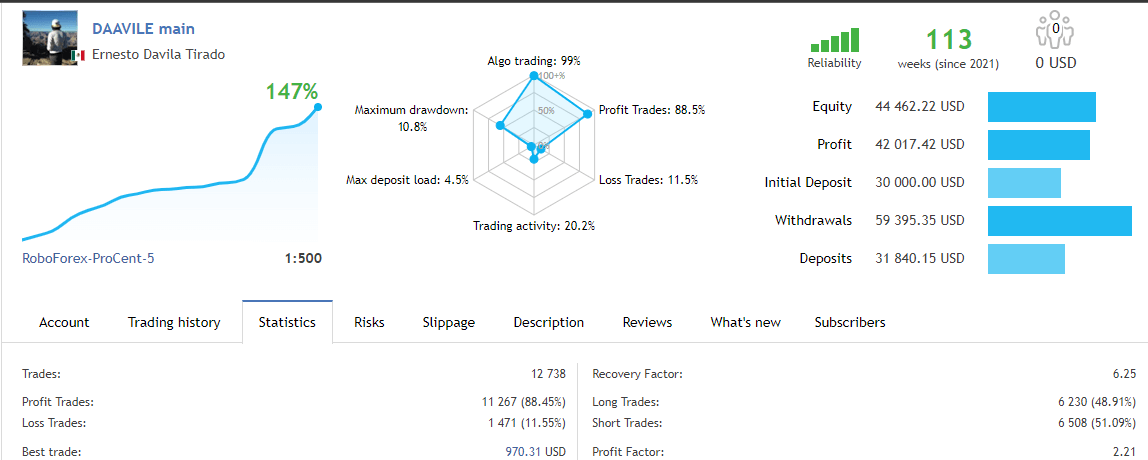
Aggressive v1+v2 stress configuration, fully compounded. Survival evidence, not client delivery.
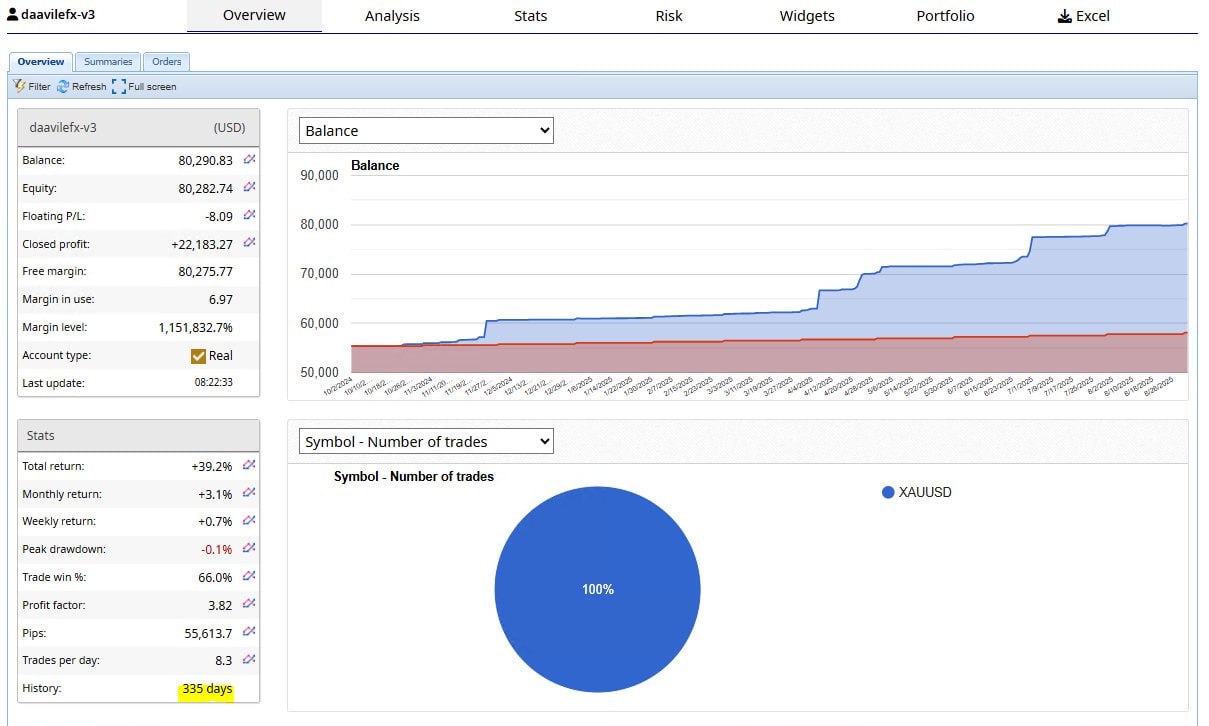
Conservative v3 client configuration, hands-off delivery, platform-verified.
Glossary
| Term | Definition |
|---|---|
| Alpha | Return not explained by market exposure |
| Beta | Sensitivity of returns to a benchmark, measured from historical data |
| Convexity | Curvature of the payoff function; short means accelerating loss |
| Gamma | Rate of change of delta |
| Vega | Sensitivity to implied volatility |
| Theta | Sensitivity to time; daily carry for short-volatility books |
| Carry | Ongoing holding cost or income: swap, rollover, financing, premium decay |
| Basket exit | Closing a group of positions by average percentage move plus retracement, first-to-last |
| Magic number | Platform identifier assigning trades to a specific logic slot |
| Cent account | Account denominated in cents; real-dollar risk per nominal lot reduced 100:1 |
| GVZ | CBOE Gold ETF Volatility Index, the gold-implied volatility measure |
| Maximal drawdown | Largest peak-to-trough decline on the closed-trade balance curve, not floating equity |
| Floating drawdown | Peak-to-trough decline in mark-to-market equity, including open baskets |
| Profit factor | Gross profit divided by gross loss |
| Expectancy | Average profit or loss per trade |
| Calmar ratio | Annualized return divided by maximum drawdown |
| Systematic trader | Rules-based directional risk taking, paid when the reversion call is right |
| Execution Kernel | Core deterministic rule engine that every other component calls |
| Kernel Configuration | The specific parameterization of the execution kernel |
| Parameter space | Full dimensional space of configurable inputs |
| Sparse activation | Only the subset of parameters relevant to the current state is live at a tick |
| Regime-conditional activation | Parameter selection changes with the market regime |
| Logic Matrix | 21 buy × 21 sell grid of configurable logic slots |
| In-sample calibration | Parameter fitting on historical data |
| Out-of-sample validation | Testing on held-out data the calibration never saw |
| Walk-forward re-calibration | Updating the configuration on a rolling basis as new data arrives |
| Sentinel position | Minimum-lot entry whose primary output is information about the state, not income |
| Cycle anchor | First open ticket, time and price of the active cycle in 18.x |
| State evaluation | Updating the operational-state estimate from each new level, without forecasting |
| Inventory cap | Maximum margin committed as a share of equity, configuration-specific |
| De-risking ratchet | Reducing multipliers as profits accumulate, so risk per unit falls over time |
| Forward-only replication | Copying only new trades from a master, excluding its accumulated drawdown |
Module map · Portfolio 2, as recorded
Magic number, module, role and observed lot size.
| Magic | Module | Role | Observed lot |
|---|---|---|---|
| 888 | ML-A | Primary ladder | 0.01 |
| 621600 | ML-B | Secondary ladder | 0.02 – 0.04 |
| 1243200 | ML-C | Fast cycle | 0.01 – 0.02 |
| 177600 | Scalp | Reversion harvesting | 0.01 – 0.03 |
| 155400 | LT-ScalpBuy #7 | Outlier ladder clip | 0.01 – 0.34 |
| 532800 | SCA | Structural continuation | 0.01 – 0.02 |
| 710400 | BRepower | Inventory repowering | 0.01 – 0.03 |
| 266400 | Stopper | Equity protection | 0.01 |
| 799200 | BScalp | Secondary scalp | 0.01 |
| 444000 | STO | Protective overlay | 0.01 |
| 355200 | LT | Long-term structural | 0.01 – 0.02 |
Document status: living · Disclosures and open items updated as evidence closes · Track record figures drawn from platform-verified statements, subject to independent verification on request · Version 1.0 · Investor edition