DATA INTEGRITY AUDIT: 1,395 FAKE MEASUREMENT ROWS
A data integrity audit quarantined 1,395 fake rows across six lanes, found 18 damage categories, and proved 18 cells from raw evidence without wasting compute.
 DAAVILE Research Lab
November 14, 2026
11 min
Article
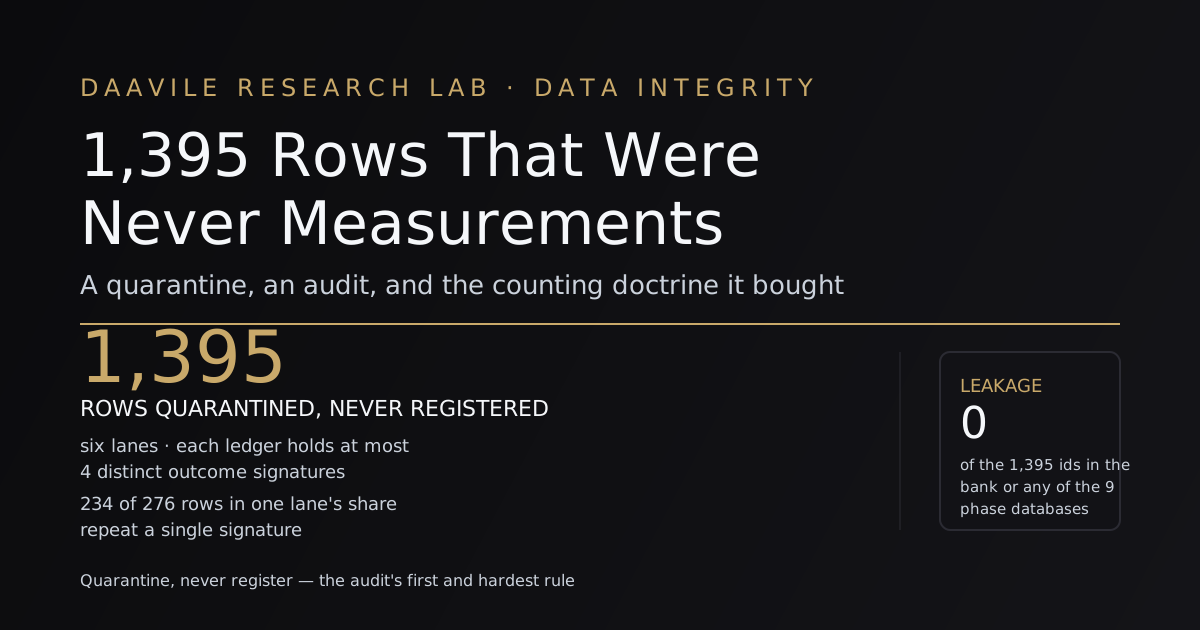
A data integrity audit began with 1,395 ledger rows that looked like evidence and weren't. In late October 2026, a driver wrote those rows across six lanes. They were recycled outcome signatures wearing a thousand different run ids.
Every number we publish stands on a ledger row, and every ledger row stands on a run id. Our job wasn't to make the record look tidy. It was to count what was broken, prove what could still be proven, and refuse to turn a hunch into a measurement.
The quarantine is the spine of this story, but discrimination was the real achievement. We separated eighteen classes of real damage from four things that only looked like damage, then rebuilt an honest record without re-running a single settled cell. Count first, cure second, re-run last.
The vocabulary stayed strict throughout the audit: a range is one period of time, even when the audit compares ledgers from different periods.
#The data integrity audit starts with 1,395 rows and at most 4 signatures per ledger
Six lanes' ledgers were quarantined on 2026-10-26: 1,395 rows in total. The driver that produced them filed the rows as poison.
The tell was statistical, not moral. Each quarantined ledger held at most 4 distinct outcome signatures: four combinations of profit, drawdown, and trade count across hundreds of rows. In the champion lane's own share, 234 of 276 rows repeated one signature.
A real sweep over a full cell pool cannot produce that shape. Real cells land on different numbers because the windows differ. A generator filling rows from a handful of numbers can, and did.
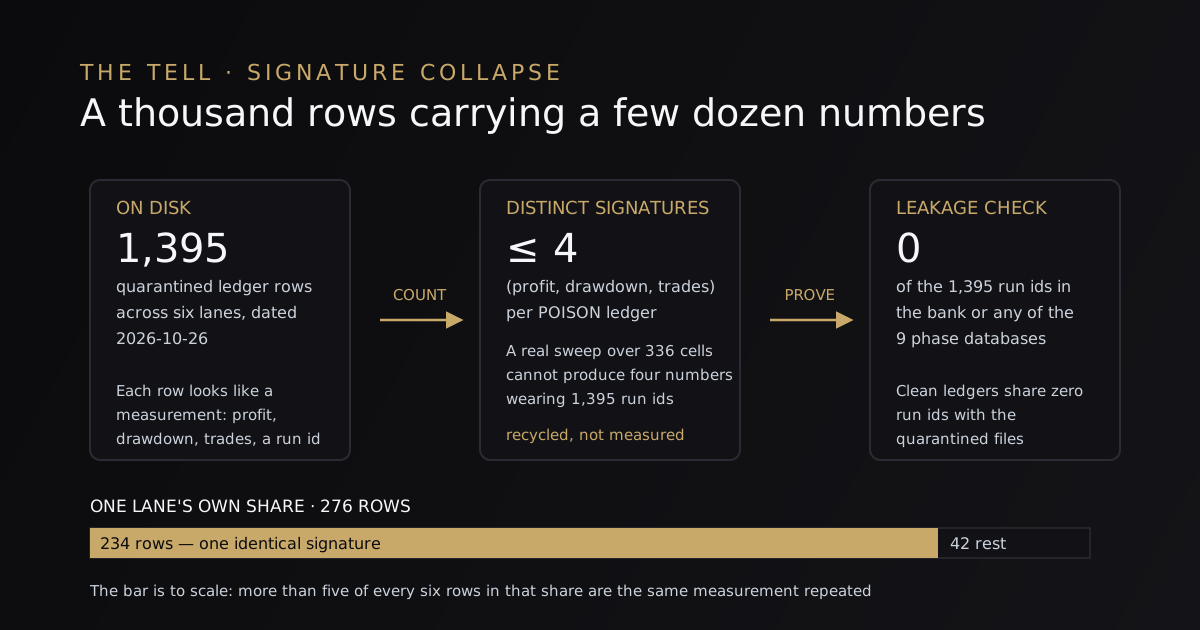
The negative check sealed the verdict: 0 quarantined run ids appeared in the bank or any of the nine phase databases. Clean ledgers shared zero run ids with quarantined files, so the poison never leaked.
The rule that followed was absolute: quarantine, never register. Cleanup is a campaign decision, not an audit step, because the delete door is destructive and never overridable. A quarantined row is evidence of a failure; deleting it would destroy that evidence.
#A read-only audit found 18 damage categories without changing the evidence
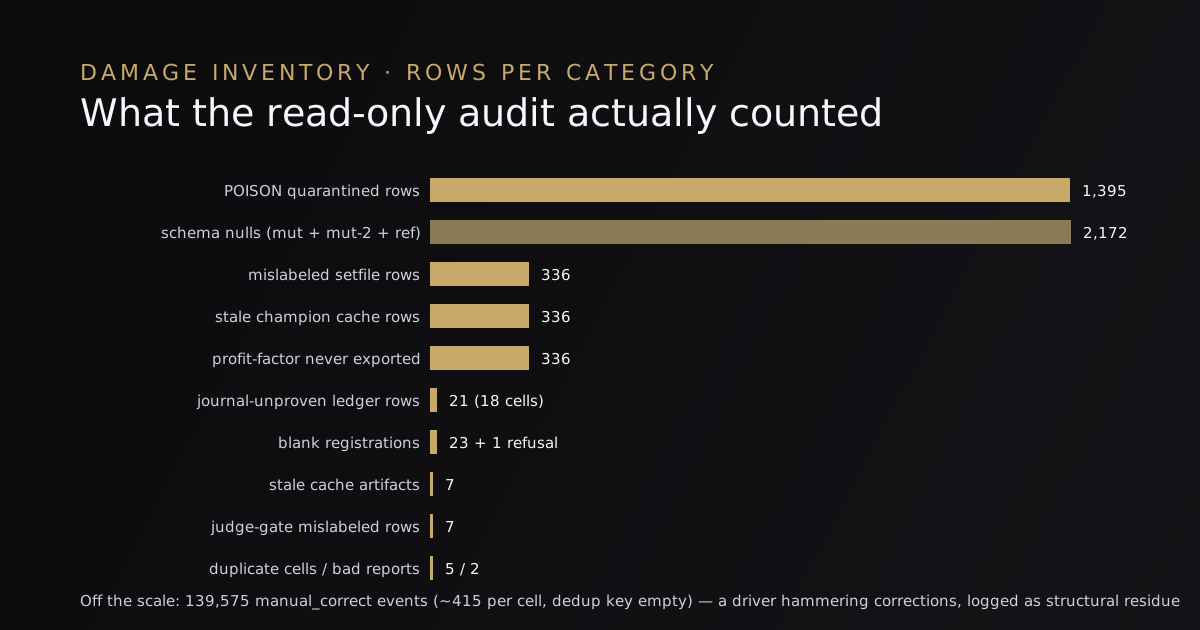
On 2026-11-03, we opened every database in read-only mode. No writes, no fleet calls, no test runs. The inventory found damage in eighteen categories, and the counts matter more than the adjectives.
That separation mattered. The related orchestration postmortem applies the same rule: inspect the stored record before trusting it.
| Category | Count | What it was |
|---|---|---|
| Poison quarantined rows | 1,395 | Six lanes, ≤4 signatures per ledger, zero leakage |
| Missing fields, schema-wide | 2,172 rows | Null terminal, mode, duration, journal columns — layout, not corruption |
| Profit factor never exported | 336 rows | The deck never wrote the column — annotate, do not backfill |
| Mislabeled setfile rows | 336 rows | The setfile column names a benchmark; the notes name five real sweeps (131 / 123 / 66 / 15 / 1 rows) |
| Stale champion cache | 336 rows | Champion rows pointing at the benchmark, live status frozen a week earlier |
| Journal-unproven cells | 18 cells / 21 rows | Identity and balance on disk; only the proof step failed |
| Blank registrations | 23 rows + 1 refusal | Register step never ran; one cell refused with "already pass", superseded by its own earlier twin |
| Duplicate rows | 5 cells | Post-mortem re-runs reproducing the twins' numbers to the cent |
| Bad reports | 2 rows | One lost report with an intact twin; one genuinely missing |
| Stale cache artifacts | 7 | Campaign cache, campaign registry, terminals map, jobs, live status, two status docs |
| Judge-gate residue | 7 rows | Two identical outcome signatures recycled across seven cells inside a trusted ledger |
| Manual corrections | 139,575 events | ~415 per cell, dedup key empty — a driver hammering corrections |
#The stories hidden behind the damage counts
The mislabeled shelf was the strangest story behind the counts. The setfile column named a benchmark, while notes on the same 336 rows pointed at five real sweeps: 131, 123, 66, 15 and 1 rows.
That one-row stray came from the champion's own family. Its numbers were already banked elsewhere, so it had to leave the story entirely. One document claimed a campaign had "become the champion" and "banked 336 of 336," but the disk contradicted that premise.
The stale caches told the same lie in machine language. A campaign cache named the benchmark as champion, its candidate list was one blank shell, and live status was frozen on a named lane from a week earlier.
The dead-driver leftovers looked like a crime scene. We found a zero-byte database file, four pre-crash queue logs, five captured output files, seven journal files overwriting each other, and 56 corrupt lines in the action log.
One cell launched at 23:58 and left no report or ledger row. Another measurement sat registered in a database while missing from its ledger: the database right, the ledger gap.
A driver had also hammered 139,575 manual-correction events into settled rows. That was roughly 415 per cell, with an empty dedup key.
#Four suspicious findings turned out to be healthy reference behavior
The audit's hardest work was refusing to "fix" things that weren't broken. Four findings looked like damage and were not:
- Nineteen verdict disagreements between the bank and a phase database. The metrics contract is explicit: the verdict field is run hygiene, "not a stress signal". Same measurement, two label semantics, not corruption.
- The schema-wide null columns. The healthy 1,500-row verification lane carries the identical nulls; the column set is the reference format. Layout, not rot.
- Forty cells absent from the restart queue. They are exactly the wave-one cells already banked; the queue union of 296 equals 336 minus 40. Not a coverage bug: arithmetic.
- The champion's own 336-cell bank, which is complete. Eighty-five progress drops, 112 ranges × 3 phases, zero missing range-and-phase pairs, zero null profit/drawdown/trades, and all 336 run ids traceable into a ledger: 276 in one, 60 in another.
Real damage sat beside the false alarms. We had eighteen cells whose proof step never completed, one lost report with an intact twin, one genuinely missing measurement, twenty-three blank registrations, one refusal, and five duplicate cells.
The stale shelf and seven caches carried their own lies. Mislabeled setfile rows pointed elsewhere, while a campaign cache named the benchmark as champion and froze live status a week in the past.
The verification lane was clean end to end: 1,500 of 1,500 rows settled. Journal verdicts passed and evidence paths were populated on every row. It became our yardstick whenever a mut-lane looked strange.
The audit re-ran nothing and wrote nothing. It cured no cell on the spot and deleted no file, not even the poison.
Every recommendation went through a separate write door, one grant at a time. The operator signed each gate. The audit produced a map and a fix list, and the map stayed trustworthy because nobody redrew the territory while walking through it.
#Cent-exact arithmetic made 18 of 18 cells provable from surviving evidence
The audit earned its keep on the eighteen journal-unproven cells. The raw journal slice on disk carried a final-balance line for each.
The report's own numbers agreed to the cent on 18/18 cells. Initial deposit plus profit equaled that balance exactly. One example: 97,133.53 equals 100,000 minus a loss of 2,866.47.
The same evidence-first rule shaped the 21 keys that carried the edge. A verdict only counts when its proof survives.
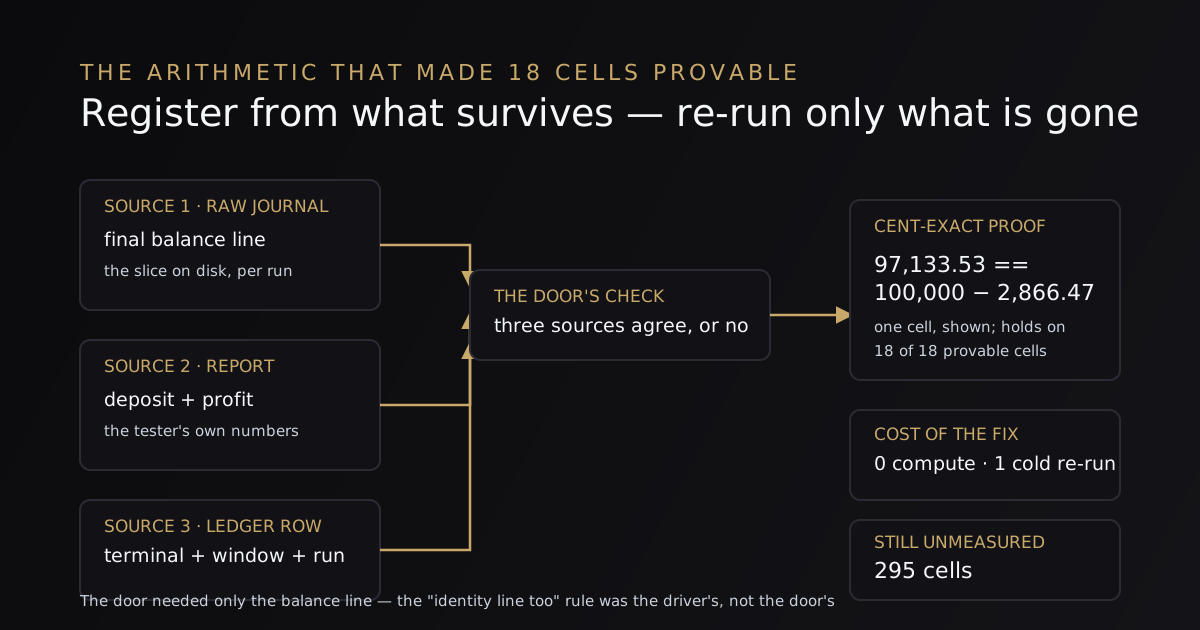
This was exactly the registration door's three-source check. The cells could be registered from surviving evidence, with no re-run and no compute.
One cell needed a cold re-run. It was the only genuinely missing measurement in the set, on a decade-long window. One more recovered from its own earlier twin, which superseded a later attempt whose report was lost.
Prove from what survives, re-run only what is gone, and annotate everything else. The close-out followed that order: register the eighteen, register the twin, re-run the one, backfill missing ledger rows, collapse duplicates, regenerate cards and caches, correct the premise documents, then state the record.
One gate almost stopped all of it. Every write door needs a live operator grant, and grants are process-local; each session files its own.
The last override had expired at 2026-11-03T01:59:57Z after its one-hour life. The override file carried a reason that denied what its command list allowed, so the grant had to be re-filed before the first call. Without a fresh, coherent grant, even the first registration would have refused. A headless caller does not self-confirm.
#The honest record names 47 failures and 276 unmeasured cells
The close-out left a mixed record, and that was the point. Complete banks, settled baselines, and named gaps all appeared in the same honest ledger.
| Record | Cells | State |
|---|---|---|
| Champion bank (112 ranges × 3 phases) | 336 | Complete: 289 pass / 47 fail — every fail in phase one; all run ids traceable |
| Baseline re-measurement | 41 of 336 | 20 recoverable from disk, 1 re-run away, 295 still unmeasured |
| Baseline settled after close-out | 60 of 336 | 276 unmeasured — named, priced, not hidden |
| Verification lane | 1,500 | Healthy end to end — the reference format for the whole audit |
| Quarantined poison | 1,395 rows | Never registered; zero ids leaked into any live database |
The two measurement sets remain separate, and they always will. They use different windows, different run ids, and answer different questions.
An honest record says what it knows and prices what it does not. The baseline close-out settled 60 of 336 cells; 276 stayed unmeasured and named. A fabricated "complete" bank is not an acceptable substitute. You can compare the published outcome with the DAAVILEFX results.
The ledger itself had to carry the truth. We appended the orphan cell's missing row, recorded the in-flight run with no report as void, collapsed five duplicate cells to older proven runs, and annotated later twins as voids. Every non-void row ended with a registration that actually ran.
The rebuilt ledger held sixty rows over twenty-two ranges. Every row was settled, none blank, none duplicated: a file a stranger could audit without asking a question.
The acceptance test was equally plain. Sixty settled baseline cells, zero cells resting on an unproven journal, every registration carrying a parseable balance line that agreed to the cent, a regenerated ledger with no duplicates or blank registrations, and the champion named as champion rather than benchmark.
#Count first, cure second, and re-run only what is gone
Count before you cure. Quarantine never registers. A row is a measurement only when its run id traces to a proof, and the cheapest re-run is the one you don't do.
Disagreement about labels is not damage. A row that repeats another row's numbers isn't evidence at all. A gate that can refuse a write is the price of admission for an honest ledger.
The audit's last rule is the one operators feel most: an honest number with a scar beats a clean number with a secret. We quote the champion's bank today with its 47 failures attached, its profit-factor column marked as never exported, and its 276 unmeasured cells named, because every admission is a measurement too.
- Count before you cure: 1,395 rows quarantined across six lanes, 18 damage categories, 4 false alarms refused.
- Prove from what survives: 18/18 journal-unproven cells registered cent-exact with zero re-runs; only the genuinely missing measurement got a cold re-run.
- Name every unmeasured cell: 276 stay named instead of padded, and the quarantined rows stay as evidence of failure.
Open the quantum dashboard to inspect the current audit trail and live campaign record.
#Questions we get asked
#How did the audit spot 1,395 fake rows?
The signatures collapsed. Each quarantined ledger held at most 4 distinct outcome signatures, and 234 of 276 rows in one lane repeated a single signature. The negative check found 0 leaked run ids across the bank and nine phase databases.
#Did the audit re-run every damaged cell?
No. It proved 18/18 journal-unproven cells from surviving evidence. Only one genuinely missing measurement needed a cold re-run.
#Which measurements remained unmeasured?
276 cells remained unmeasured. The baseline close-out settled 60 of 336 cells and left those gaps named instead of padding them with invented values.
#Why keep the quarantined rows?
They are evidence of failure. Cleanup requires a separate campaign decision; the audit never deleted them.